
Table of Contents
- 1. The best adhesive for skin depends on what you’re doing
- 2. What can I use to stick something to my skin?
- 3. What do hospitals use to glue wounds?
- 4. How long does adhesive last on skin?
- 5. Who should not use skin adhesive?
- 6. What is skin adhesive called?
- 7. Can I use superglue as skin glue?
- 8. What is the strongest adhesive ever?
- 9. What is the strongest adhesive to buy?
- 10. So what’s the best adhesive for skin?
If you search “the best adhesive for skin,” you’re usually trying to do one of three things:
- Keep something on your skin (a dressing, device, costume, or patch) for hours or days
- Close a minor cut safely
- Stop adhesive from failing early, peeling, or irritating skin
The right choice depends less on “strongest” and more on purpose, skin condition, and how removal will work. This guide breaks down the main options and answers the most common follow-up questions.
This article is for general information, not medical advice. For wound closure, infection risk, and injury care, follow local clinical guidance or consult a qualified clinician.
The best adhesive for skin depends on what you’re doing
Before picking anything, sort your use case into the right category:
- Skin-safe temporary adhesives: medical tapes, transparent films, kinesiology tape, liquid bandage, skin-safe adhesive sprays
- Medical tissue adhesives (skin glue): used by clinicians to close certain wounds, usually cyanoacrylate-based
- Skin prep adhesives: liquids that help tapes and dressings stick better (often used in hospitals)
Mixing these up is where most bad outcomes come from.
| If you need to... | Best starting point | Why it’s the best fit | Common failure modes |
|---|---|---|---|
| Keep a dressing or device on skin for 1-7 days | Medical tape + transparent film (or a film dressing) | Designed for skin wear and removal; many options for sensitive skin | Sweat, oils, hair, friction at edges |
| Hold an item on skin for a few hours (costume/props) | Skin-safe adhesive or body adhesive made for skin | Removes cleaner than industrial hardware adhesives | Skin irritation; sticky residue |
| Seal a minor, superficial cut (not gaping) | Liquid bandage (OTC) | Fast barrier layer; designed for small skin cracks | Stings on application; cracks on joints |
| Close a clean, straight laceration with approximated edges | Clinician-applied skin glue (2-octyl cyanoacrylate) | Fast closure, no suture removal required in appropriate wounds | Wrong wound type, moisture, tension, infection |
| Get tape to stick to difficult skin (oily, frequent lifting) | Skin prep adhesive (Mastisol/benzoin) + tape | Significantly increases initial tack for securement | Allergic contact dermatitis; skin injury with removal |
What can I use to stick something to my skin?
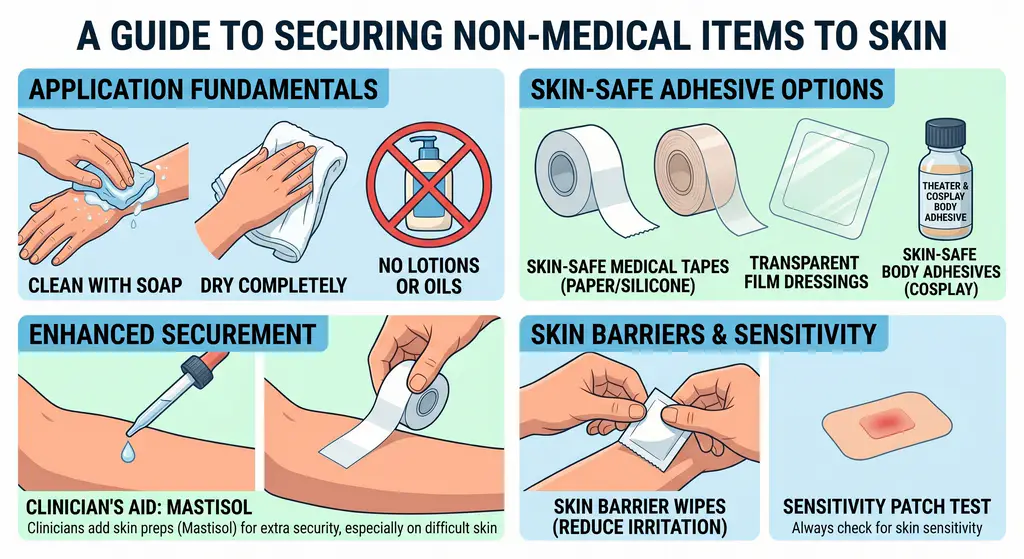
For non-medical attachments (props, wearable items, temporary patches), start with products that are explicitly labeled as skin-safe:
- Medical tapes (paper/silicone for sensitive skin; fabric or acrylic for longer wear)
- Transparent film dressings (often used for IV sites and wound coverings)
- Skin-safe body adhesives (common in theater/cosplay)
- Skin barrier wipes (not an adhesive, but can reduce irritation and improve wear)
If you’re securing something important (a dressing edge, a device patch), treat it like an adhesive engineering problem:
- Clean (soap and water), then dry completely
- Avoid lotions and oils under the adhesive zone
- Choose a product made for the wear time you need
If you need extra help with securement, clinicians often add a skin prep adhesive such as benzoin or Mastisol, but those can irritate some skin types. The allergy section below matters.
What do hospitals use to glue wounds?
How long does adhesive last on skin?
It depends on the adhesive category:
- Medical skin glue (tissue adhesive): the film typically sloughs off on its own in about 5–10 days in many standard use cases, as noted in clinical guidance such as the Perth Children’s Hospital Dermabond guideline.
- Medical tapes/films: wear time varies by product and location. Edges can lift early on high-friction areas (hands, joints) or high-moisture zones.
- Skin-safe body adhesives: often last hours, sometimes longer, but removal and irritation risk tends to rise with time.
Variables that shorten wear time:
- Sweat and showering
- Oily skin or skincare products under the adhesive
- Hair, body contours, and frequent movement (knees, elbows, knuckles)
- Abrasion (clothing rubbing the edge)
Who should not use skin adhesive?
The answer depends on which “skin adhesive” you mean.
If you mean medical skin glue for wound closure
- Infected or contaminated wounds
- Bites, puncture wounds, or crush injuries
- Jagged wounds or wounds under high tension
- Mucosal surfaces or high-moisture areas (such as axilla/perineum)
- Areas likely to be soaked with body fluids
- Known hypersensitivity to cyanoacrylates
If you mean medical skin glue for wound closure
If you mean tape, film dressings, or body adhesives
Avoid or patch-test if you:
- Have fragile or compromised skin (eczema flares, steroid-thinned skin, recent burns)
- Have a history of adhesive-related rash or blistering
- Need removal from high-risk areas (thin skin, frequent reapplication)
If you see blistering, spreading redness, or severe itching after 24–48 hours, stop use and seek clinical advice. That pattern can be allergic contact dermatitis.
What is skin adhesive called?
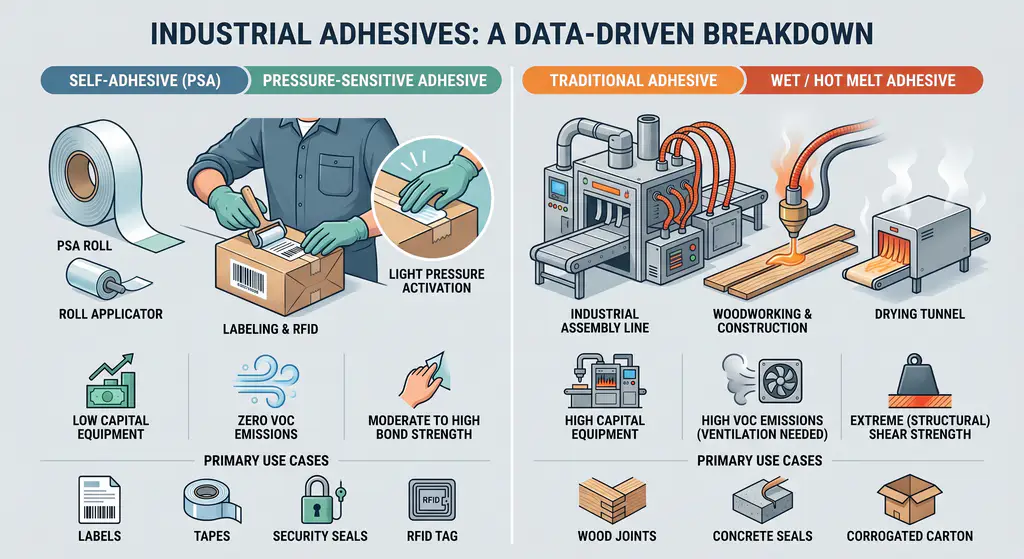
The table below provides a data-driven breakdown of self-adhesive vs. adhesive formats to help procurement managers optimize their assembly lines.
Avoid or patch-test if you:
| Metrics | Self-Adhesive (PSA) | Traditional Adhesive (Wet/Hot Melt) |
|---|---|---|
| Activation Method | Light pressure only (Instant) | Heat, solvent evaporation, or UV curing |
| Capital Equipment | Low (Roll applicator only) | High (Heated hoses, drying tunnels) |
| VOC Emissions | Zero (Cured at factory) | High (Requires factory ventilation) |
| Bond Strength | Moderate to High (Peel resistance) | Extreme (Structural shear strength) |
| Primary Use Case | Labeling, Tapes, RFID, Security Seals | Woodworking, Construction, Corrugated Carton Sealing |
What is skin adhesive called?
Common names vary by category:
- Medical tissue adhesive / skin glue: typically cyanoacrylate-based (often 2-octyl cyanoacrylate)
- Topical skin adhesive: broader clinical term; DermNet’s overview is Topical skin adhesives
- Skin prep adhesive: benzoin tincture / compound benzoin tincture / Mastisol (used to improve tape/dressing adherence)
- Medical tape / transparent film dressing: for securement rather than “gluing skin”
If you’re purchasing, look for labeling that clearly states the product is intended for skin contact and specifies the use case. If the listing says “medical skin adhesive,” confirm whether it’s a tissue adhesive for wound closure or a skin prep adhesive meant to help tapes and dressings stick, because those are not interchangeable.
Can I use superglue as skin glue?
No. Don’t use household super glue on skin or wounds.
Medical tissue adhesives are formulated and tested for skin use. Consumer cyanoacrylates are not. The Mayo Clinic Health System’s guidance explains why this is a bad idea and when medical adhesives, used appropriately, make more sense.
What is the strongest adhesive ever?
There isn’t one universal “strongest adhesive ever,” because “strong” depends on:
- The substrates (skin, metal, plastic, glass)
- The test method (peel strength vs shear strength vs tensile)
- Conditions (humidity, temperature, oils, movement)
Some structural industrial adhesives can outperform skin-safe adhesives by orders of magnitude on lab tests, but they are not safe for skin contact.
A better way to ask the question for skin is: strong enough for what wear time, and removable without injury?
What is the strongest adhesive to buy?
If you’re buying for skin contact, “strongest” should mean:
- Holds under realistic conditions (sweat, movement, showering)
- Doesn’t cause skin injury on removal
- Has clear instructions for use and removal
In practice:
- For longer wear on skin, many people get the best results from medical tapes/films plus good prep.
- For hard-to-stick situations, clinicians may use skin prep adhesives to improve tack, but allergy risk increases.
- For wound closure, medical skin glue is strong in the right wound type, but it’s not a consumer “strongest glue” purchase category.
If you’re buying for industrial bonding (not skin), that’s a different selection process entirely.
So what’s the best adhesive for skin?
For most everyday “stick something to skin” needs, start with medical tapes or transparent film dressings. They’re designed for skin wear, come in versions for sensitive skin, and have predictable removal behavior.
If your real goal is wound closure, the best answer is usually medical skin glue used under appropriate clinical guidance, not a household adhesive.
And if your goal is device securement under heat, moisture, or friction, treat it like a controlled test: skin prep, the right backing, the right adhesive chemistry, and clear removal instructions.
Next steps (for teams evaluating adhesive materials)
If you’re evaluating adhesive-backed materials for demanding packaging or labeling applications, the same mindset applies: define the substrate, the environment, and the failure mode you can’t accept.
You can review Why Jumelage for a snapshot of quality systems, explore Self-Adhesive vs. Adhesive: 5 Crucial B2B Differences for materials terminology, and reference Choosing GMP Certified Adhesive Materials for Medical and Pharmaceutical Labels for a compliance-first view of adhesive-backed materials.
And if your goal is device securement under heat, moisture, or friction, treat it like a controlled test: skin prep, the right backing, the right adhesive chemistry, and clear removal instructions.
Best Adhesive For Skin
If you already know your substrate and failure mode, you can also request a quote with your application conditions.
