
Table of Contents
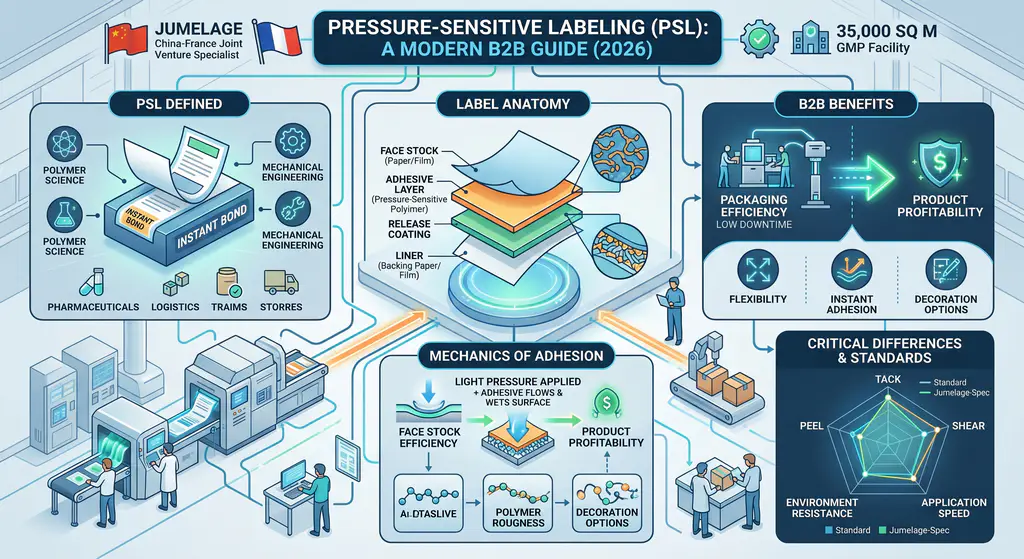
In the modern B2B manufacturing landscape, the efficiency of a packaging line often dictates the profitability of a product. To optimize these processes, engineers and procurement managers must ask: what is pressure-sensitive labeling? As a specialized China-France joint venture operating a 35,000㎡ GMP-certified facility, Jumelage views this technology not just as a “sticker” application, but as a complex interplay of polymer science and mechanical engineering.
Understanding what is pressure-sensitive labeling is essential for industries ranging from pharmaceuticals to high-end logistics. In this 2026 guide, we will dissect the anatomy of the labels, the mechanics of adhesion, and the critical differences that define market standards.
Understanding adhesives is only part of the equation. Learn how Facestocks and Liners work together in our comprehensive breakdown: The Ultimate Guide to Self-Adhesive Packaging Materials: Adhesives, Liners & Facestocks ➔
What are Pressure-Sensitive Labels?
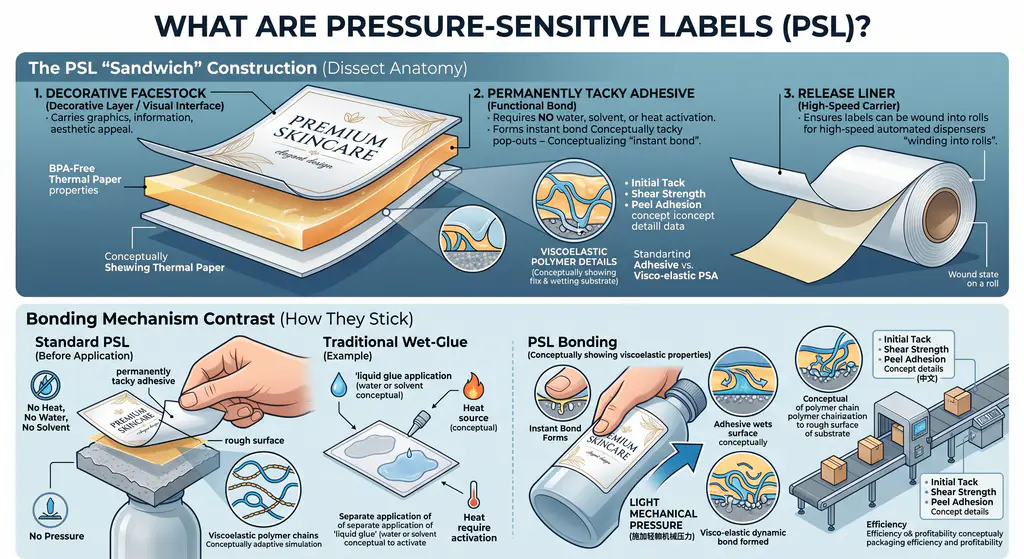
Pressure-sensitive labels (PSL) are self-adhesive materials that bond to a surface through the application of light mechanical pressure. They consist of a three-layer “sandwich” construction: a decorative facestock, a permanently tacky adhesive layer, and a release liner. Unlike wet-glue labels, they require no water, solvent, or heat to activate the bond.
To fully grasp what is pressure-sensitive labeling, one must understand the role of each component. The facestock, which we often produce as BPA-Free Thermal Paper, provides the visual interface. The adhesive layer, detailed in our Pressure-Sensitive Adhesive (PSA) Guide, provides the functional bond. Finally, the liner ensures the labels can be wound into rolls for high-speed automated dispensers.
What is the Difference Between Pressure-Sensitive and Self-Adhesive Labels?
In the labeling industry, there is no functional difference between pressure-sensitive and self-adhesive labels. Both terms describe the same technology where a pre-applied adhesive bonds upon contact. “Self-adhesive” is the common consumer term, while “pressure-sensitive labeling” is the technical engineering term used in manufacturing and professional supply chains to describe the application process.
This linguistic overlap often causes confusion for new buyers. When we explain what is pressure-sensitive labeling to our global clients, we clarify that the “pressure” refers to the mechanical force (measured in Newtons) required to marry the label to the substrate. This is a far more precise description than “self-adhesive,” which implies the label sticks on its own without external influence. For a deeper comparison of bonding agents, see our Self-Adhesive vs. Adhesive differences report.
The Science of Adhesion: How It Works
To answer what is pressure-sensitive labeling from an engineering perspective, we must look at Viscoelasticity. Unlike structural glues that harden into a solid, the adhesives used in pressure-sensitive labeling remain in a “liquid-like” state that can flow into the microscopic valleys of a surface.
1. Van der Waals Forces
The primary bonding mechanism in what is pressure-sensitive labeling is not a chemical reaction, but physical attraction at the molecular level known as Van der Waals forces. This is why surface energy is critical; a label will bond more strongly to high-energy surfaces like glass or stainless steel than to low-energy plastics like polyethylene.
2. Dwell Time and Adhesion Build-up
A common misconception in what is pressure-sensitive labeling is that the bond is instantaneous. While the “initial tack” is immediate, the ultimate bond strength is achieved over a “dwell time” of 24 to 72 hours, as the adhesive continues to “wet out” the surface. We discuss this further in our guide: Is self-adhesive easy to remove?.
| Property | Paper-Based PSL | Film-Based (BOPP/PET) | Specialty (Medical/Cold Chain) |
|---|---|---|---|
| Testing Protocol | FINAT FTM 1 | ASTM D3330 | ISO 29862:2018 |
| Service Life | 12-24 Months | 3-5 Years | 7+ Years |
| Chemical/UV | Low | High | Extreme |
| Best Substrate | Cardboard/Paper | Plastic/Glass | Vials/Medical Equipment |
Manufacturing Standards for B2B Supply Chains
When a business evaluates what is pressure-sensitive labeling, they are often looking for stability and compliance. At Jumelage, we manufacture every roll according to the following standards:
- GMP Compliance: Essential for medical and pharmaceutical labels, ensuring zero contamination in the adhesive layer.
- Migration Testing: We use low-migration adhesives to prevent chemical leaching into food or drug products, a critical factor when defining what is pressure-sensitive labeling for the FMCG sector.
- Climate Stability: Since we ship globally, our labels are tested for shelf life in high-humidity environments. Learn more in our shelf life guide.
Why Choose PSL Over Shrink Sleeves or Wet Glue?
While exploring what is pressure-sensitive labeling, many buyers compare it to other methods. The advantage of PSL is its “dry” application. There is no mess from liquid glues and no need for energy-intensive heat tunnels required by shrink sleeves. This makes what is pressure-sensitive labeling the most sustainable and efficient choice for high-speed production lines.
Implementing the Right Strategy
Answering what is a PSL label reveals a technology that is far more than just “stickers.” It is a multi-disciplinary engineering solution that combines polymer science, high-speed logistics, and brand psychology. For the B2B sector, the PSL label offers an unmatched combination of speed, durability, and visual excellence.
Whether you are navigating the complexities of Cold Chain logistics or launching a new line of premium spirits, the choice of material matters. Explore our Full Technical Catalog of Self-Adhesive Materials or consult with our material scientists to customize your next project.
