
Table of Contents
- 1. What Are Sustainable Materials in the Labeling Industry?
- 2. 5 Examples of Sustainable Self-Adhesive Materials
- 3. What Makes a Material Sustainable? The 4-Pillar Framework
- 4. How to Know If a Material Is Truly Sustainable
- 5. The Most Sustainable Material: A Technical Comparison
- 6. 10 Materials That Can Be Recycled in Label Applications
- 7. Why Sustainable Sourcing Matters for Global Buyers
Sustainable Self-Adhesive Materials: A 2026 Engineering Guide to Eco-Friendly Labeling
At Jumelage, we have spent the last decade engineering self-adhesive materials that meet both performance requirements and environmental accountability. This guide breaks down what sustainability actually means in the pressure-sensitive adhesive industry, which materials qualify, and how to verify claims before placing your next order.
This article is for general information, not medical advice. For wound closure, infection risk, and injury care, follow local clinical guidance or consult a qualified clinician.
What Are Sustainable Materials in the Labeling Industry?
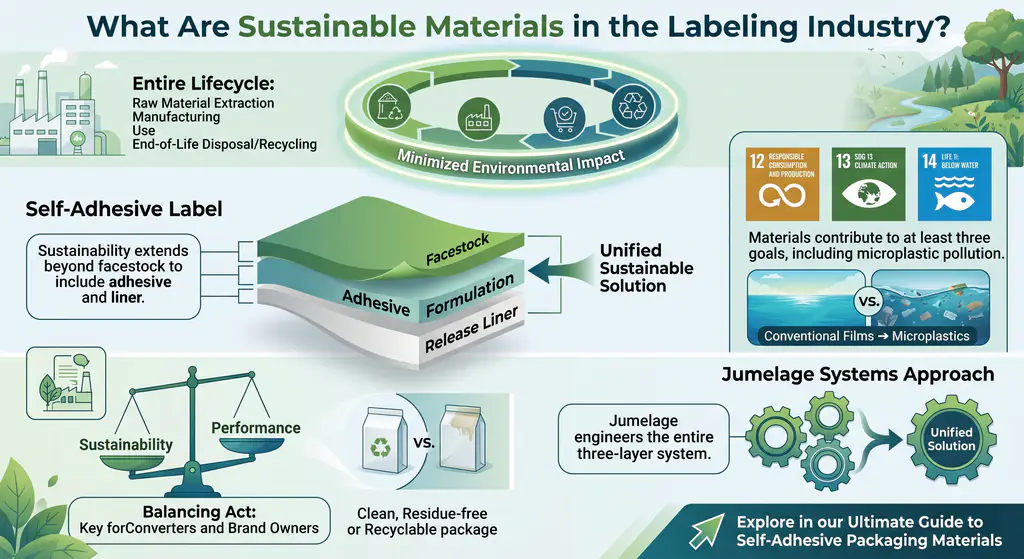
A sustainable material is one that minimizes environmental impact across its entire lifecycle—from raw material extraction through manufacturing, use, and end-of-life disposal or recycling. In the self-adhesive industry, this definition extends beyond the facestock to include the adhesive formulation and the release liner.
According to the United Nations Sustainable Development Goals (SDGs), sustainable materials contribute to at least three of the 17 goals: Responsible Consumption and Production (SDG 12), Climate Action (SDG 13), and Life Below Water (SDG 14) when considering microplastic pollution from conventional films.
For label converters and brand owners, the challenge lies in balancing sustainability with performance. A biodegradable paper facestock means nothing if the adhesive leaves permanent residue on recyclable packaging. This is why Jumelage engineers the entire three-layer system—facestock, adhesive, and liner—as a unified solution. We explore this systems approach in our Ultimate Guide to Self-Adhesive Packaging Materials.
5 Examples of Sustainable Self-Adhesive Materials
When procurement teams ask “what is an example of a sustainable material?” they typically want specific product names they can specify in RFQs. Here are five proven options currently available at industrial scale:
1 FSC-Certified Kraft Paper Facestock
hat it is: Uncoated paper sourced from Forest Stewardship Council (FSC) certified forests, featuring high tensile strength and a natural rustic appearance.
Why it’s sustainable: The raw material comes from responsibly managed forests that provide environmental, social, and economic benefits. FSC certification ensures traceability from forest to final product.
Best applications: Organic food packaging, craft beverage labels, eco-conscious consumer goods. The natural aesthetic aligns with brands positioning themselves as authentic and environmentally responsible.
Limitations: Not suitable for applications requiring high moisture resistance or extended outdoor exposure without additional coatings.
2 Stone Paper (Mineral-Based Substrate)
What it is: A tree-free material made from calcium carbonate (80-85%) bonded with a small amount of non-toxic polyethylene (15-20%). No water is used in production.
Why it’s sustainable: Zero deforestation, significantly lower carbon footprint than traditional paper, and fully recyclable into plastic streams. The manufacturing process uses 50% less energy than conventional paper production, according to research published by the European Commission’s Science for Environment Policy.
Best applications: Premium cosmetic labels, luxury packaging, outdoor applications requiring water resistance.
Limitations: Higher cost than conventional paper; not compatible with all printing technologies.
3 Bio-Based BOPP Films
What it is: Biaxially oriented polypropylene film derived partially or entirely from renewable plant-based feedstocks (such as sugarcane or corn) rather than fossil fuels.
Why it’s sustainable: Reduces dependence on petroleum-based raw materials while maintaining the same performance characteristics as conventional BOPP. The carbon footprint can be 50-70% lower than petroleum-based equivalents when sourced from certified bio-based suppliers.
Best applications: Food and beverage labeling, personal care products, high-volume retail applications requiring moisture resistance.
Limitations: End-of-life recycling infrastructure varies by region; bio-based content claims require third-party certification.
4 Water-Based Acrylic Adhesives
What it is: Pressure-sensitive adhesives formulated with water as the primary carrier instead of organic solvents.
Why it’s sustainable: Zero volatile organic compound (VOC) emissions during manufacturing and application. Safer for workers and reduces air pollution. Compatible with paper recycling streams when properly formulated.
Best applications: General product labeling, logistics applications, pharmaceutical packaging where regulatory compliance demands low VOC content.
Limitations: May require longer drying times during manufacturing; not suitable for all low-surface-energy substrates without modification.
5 Recycled PET (rPET) Release Liners
What it is: Release liners manufactured from post-consumer recycled PET bottles, providing the same silicone release performance as virgin PET liners.
Why it’s sustainable: Diverts plastic waste from landfills, reduces demand for virgin petroleum feedstock, and maintains full recyclability after use. Each ton of rPET liner saves approximately 1.5 tons of CO₂ compared to virgin PET production.
Best applications: High-speed roll-to-roll converting, pharmaceutical and medical device labeling, applications requiring dimensional stability.
Limitations: Slight color variation possible between batches; availability depends on regional recycling infrastructure.
What Makes a Material Sustainable? The 4-Pillar Framework
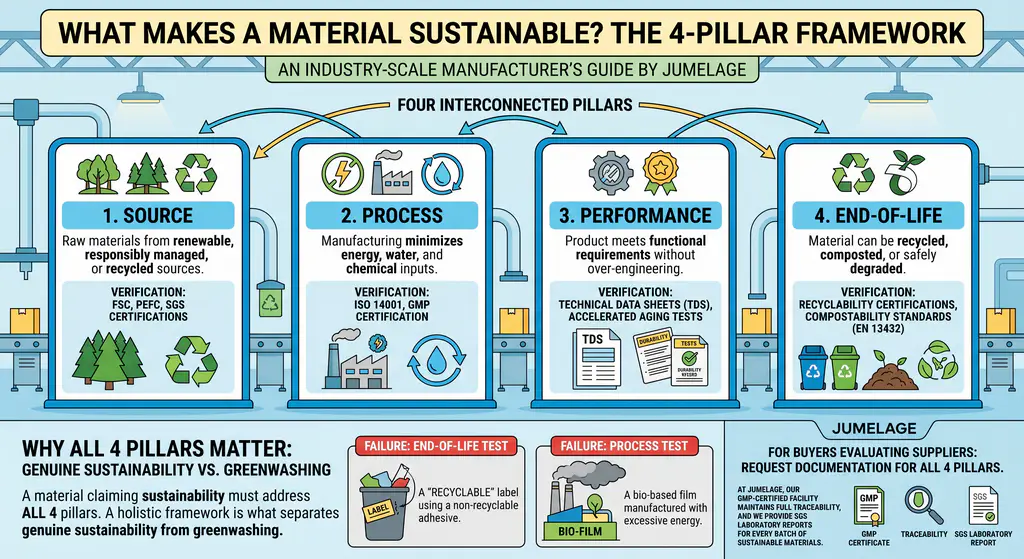
Industry standards define sustainability through four interconnected pillars. When evaluating materials, buyers should verify claims against each pillar:
| Pillar | Definition | Verification Method |
|---|---|---|
| Source | Raw materials from renewable, responsibly managed, or recycled sources | FSC, PEFC, SGS certifications |
| Process | Manufacturing minimizes energy, water, and chemical inputs | ISO 14001, GMP certification |
| Performance | Product meets functional requirements without over-engineering | Technical Data Sheets (TDS), accelerated aging tests |
| End-of-Life | Material can be recycled, composted, or safely degraded | Recyclability certifications, compostability standards (EN 13432) |
A material claiming sustainability must address all four pillars. A “recyclable” label that uses a non-recyclable adhesive fails the end-of-life test. A bio-based film manufactured with excessive energy fails the process test. This holistic framework is what separates genuine sustainability from greenwashing.
For buyers evaluating suppliers, we recommend requesting documentation for all four pillars. At Jumelage, our GMP-certified facility maintains full traceability, and we provide SGS laboratory reports for every batch of sustainable materials we produce.
How to Know If a Material Is Truly Sustainable
Greenwashing is rampant in the packaging industry. Here are five verification methods procurement teams should use:
1. Request Third-Party Certifications
Look for recognized certifications: FSC or PEFC for paper products, Cradle to Cradle for material health and circularity, and ISO 14001 for environmental management systems. Certifications from SGS, Intertek, or TÜV provide independent verification of claims.
2. Demand Full Material Disclosure
A sustainable material supplier should provide complete Technical Data Sheets including adhesive composition, liner specifications, and any coatings. Vague specifications are a red flag.
3. Check Recyclability Compatibility
“recyclable” label material must be compatible with existing recycling infrastructure. Request documentation showing the material has been tested with standard recycling processes. The Association of Plastic Recyclers (APR) provides recognition for materials meeting recyclability standards.
4. Evaluate Supply Chain Transparency
True sustainability requires traceability. Ask where raw materials originate, how they are transported, and what energy sources power manufacturing. A supplier unable to answer these questions lacks the systems for genuine sustainability.
5. Assess Corporate Commitment
Does the supplier publish sustainability reports? Have they set science-based emissions targets? Are they transparent about challenges and progress? Corporate behavior reveals whether sustainability is core strategy or marketing veneer.
The Most Sustainable Material: A Technical Comparison
There is no single “most sustainable” material—only the most appropriate material for a specific application. The table below compares leading options across key sustainability metrics:
| Material | Renewable Source | Recyclability | Carbon Footprint | Cost Premium |
|---|---|---|---|---|
| FSC Kraft Paper | ✅ High | ✅ Widely recycled | Low | 5-15% |
| Stone Paper | ✅ Partial | ✅ Plastic stream | Very Low | 20-40% |
| Bio-Based BOPP | ✅ High | ⚠️ Limited infrastructure | Medium-Low | 15-30% |
| rPET Liner | ✅ Post-consumer | ✅ Widely recycled | Low | 10-20% |
| Conventional BOPP | ❌ Fossil-based | ⚠️ Limited | High | Baseline |
There is no single “most sustainable” material—only the most appropriate material for a specific application. The table below compares leading options across key sustainability metrics:
The key is matching material properties to application requirements. Over-engineering a label for environmental conditions it will never encounter wastes resources. We discuss this optimization process in our guide on How Long Do Self-Adhesives Last.
10 Materials That Can Be Recycled in Label Applications
For buyers prioritizing circular economy principles, here are ten materials commonly recycled in label applications:
- White Woodfree Paper – Standard paper recycling streams
- Semi-Gloss Paper – Compatible with mixed paper recycling
- Kraft Paper – Natural fiber recycling
- PET Film – #1 plastic recycling stream
- HDPE Film – #2 plastic recycling stream
- PP/BOPP Film – #5 plastic recycling stream (limited infrastructure)
- Glassine Release Liner – Paper recycling stream
- PET Release Liner – #1 plastic recycling stream
- Aluminum Foil Laminate – Metal recycling (requires separation)
- rPET Film – Closed-loop plastic recycling
Critical Note: Recyclability depends on the complete label construction. A recyclable facestock combined with a permanent adhesive may contaminate the recycling stream. Always specify recyclable adhesive systems when end-of-life recycling is a requirement.
Why Sustainable Sourcing Matters for Global Buyers
The business case for sustainable self-adhesive materials extends beyond environmental responsibility:
Regulatory Compliance: The EU’s Packaging and Packaging Waste Regulation (PPWR) mandates recycled content targets and recyclability requirements. Brands selling into European markets must demonstrate compliance or face market access restrictions.
Brand Differentiation: Consumers increasingly factor sustainability into purchasing decisions. A McKinsey survey found that 66% of consumers consider sustainability when making purchasing choices, and this number rises to 75% among millennials.
Supply Chain Resilience: Sustainable materials often rely on diversified raw material sources, reducing exposure to fossil fuel price volatility and supply disruptions.
ESG Reporting: Institutional investors increasingly evaluate suppliers based on environmental, social, and governance criteria. Demonstrable sustainability practices support favorable ESG ratings.
At Jumelage, we have invested in sustainable material development not because it is trendy, but because it represents the future of industrial packaging. Our 35,000㎡ GMP-certified facility produces FSC-certified papers, bio-based films, and recyclable adhesive systems at scale, with full documentation for regulatory compliance.
Ready to Source Sustainable Materials?
Request technical samples and certification documentation for our sustainable self-adhesive portfolio.
