
Table of Contents
Choose the right custom labels for your products is a decision that impacts everything from supply chain efficiency to brand perception. In a market where 70% of purchasing decisions are made at the shelf, your label is not just a carrier of information; it is a critical component of your product’s “physical interface.” For a procurement manager or a brand owner, navigating the thousands of material and adhesive combinations can be overwhelming.
At Jumelage, our China-France joint venture heritage and 35,000㎡ GMP-certified facility provide the foundation for precision labeling. To choose the right custom labels, you must analyze the intersection of material science, environmental conditions, and application technology. In this 2026 guide, we break down the industrial criteria needed to secure your brand’s integrity.
High temperature labels are essential for maintaining traceability in 2026’s extreme industrial environments. In the high-precision world of electronics…
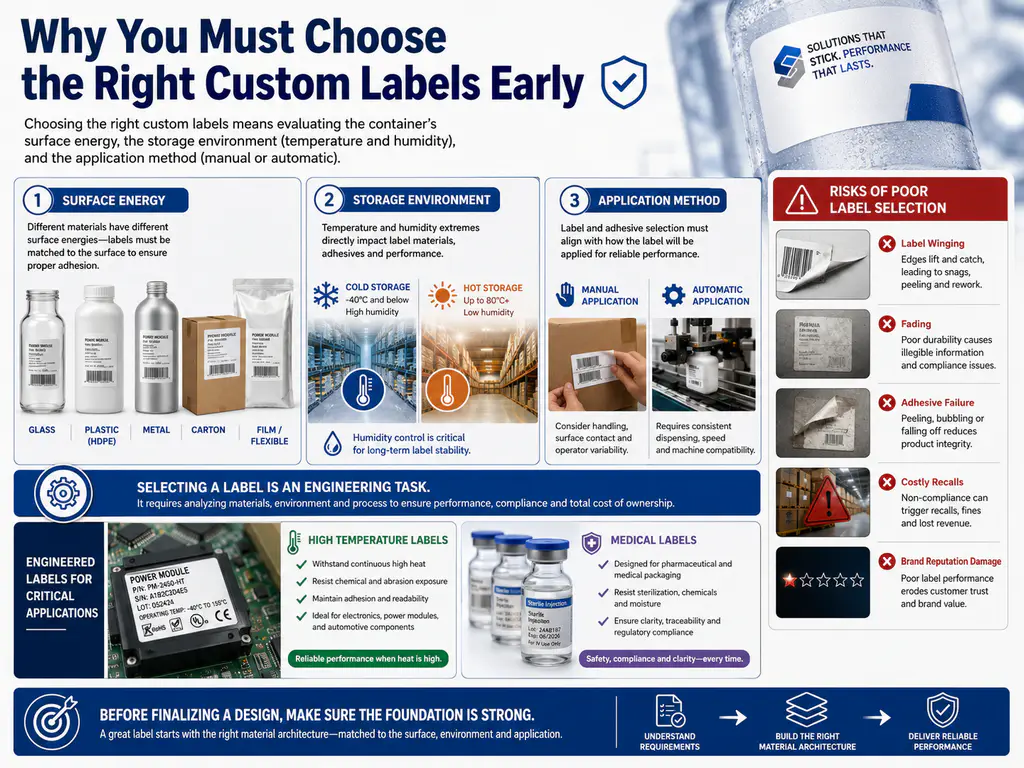
Why You Must Choose the Right Custom Labels Early
To choose the right custom labels, you must evaluate the container’s surface energy, the storage environment (temperature/humidity), and the application method (manual or automatic). Failing to align these factors leads to “label winging,” fading, or adhesive failure, which can result in costly product recalls and damage to your brand’s reputation in the B2B marketplace.
Selecting a label is an engineering task. Whether you are dealing with High Temperature Labels for electronics or specialized Medical Labels for pharmaceutical vials, the stakes are high. Before you finalize a design, you must ensure the underlying material architecture is sound.
Identify the Substrate (Surface Energy)
The first rule to choose the right custom labels is to know what you are sticking to. In material science, this is known as Surface Energy.
- High Surface Energy (HSE): Materials like glass, stainless steel, and copper are easy to bond with.
- Low Surface Energy (LSE): Plastics like Polyethylene (PE) and Polypropylene (PP) repel adhesives, requiring high-tack specialized formulations.
If you choose the right custom labels without considering the substrate, you risk delamination. For example, a label designed for a glass wine bottle will likely fail on a textured plastic engine oil container. For technical insights into how these bonds form, refer to our Pressure-Sensitive Adhesive (PSA) Guide.
Match the Environment to the Material
Environment is the “silent killer” of labels. To choose the right custom labels, you must map out the product’s entire journey:
A. Temperature Fluctuations
Will the product enter a cold chain? If so, you need Cold Chain Medical Materials that can withstand -196°C. Conversely, will it face a solder reflow oven? In that case, polyimide-based materials are required.
B. Chemical Exposure
In industrial environments, labels are often exposed to oils, solvents, or cleaning agents. To choose the right custom labels for these conditions, a protective overlaminate or a chemically resistant facestock like PET is non-negotiable.
C. Moisture and UV Resistance
Outdoor products require UV-stable inks and moisture-proof films (BOPP) to prevent fading and “silvering” (bubbles under the label). Understanding how long self-adhesives last in these conditions is a core part of supply chain planning.
The table below provides an industrial benchmark to help you choose the right custom labels based on your specific sector.
| Industry | Recommended Facestock | Adhesive Type | Key Challenge |
|---|---|---|---|
| Pharmaceuticals | White PET / PP | Low-Migration Acrylic | GMP Compliance |
| Logistics | [BPA-Free Thermal](https://www.jumelage-cn.com/what-is-bpa-free-thermal-paper/) | Permanent Hot Melt | High-Speed Scannability |
| Electronics | Polyimide (PI) | High-Temp Silicone | 260°C Reflow Oven |
| Premium Food | Textured Paper | Removable / Wash-off | Aesthetics & Recycling |
Choose Between Manual and Automatic Application
How you apply the label dictates its technical specifications. To choose the right custom labels, you must consider the “Release Force” and the “Liner Material.”
- Manual Application: Labels are peeled by hand. A standard paper liner (Glassine) is usually sufficient.
- Automatic Application: Labels are applied at speeds of 500+ units per minute. Here, a PET liner is often preferred to prevent liner breakage, and the What is a PSL Label? construction must be precision-engineered for consistent dispensing.
When you choose the right custom labels, always share your applicator’s speed and tension settings with your manufacturer to avoid production bottlenecks.
Understanding Regulatory Standards (EEAT Focus)
In B2B manufacturing, you cannot simply choose the right custom labels based on price. Compliance is the foundation of market entry.
- ISO 9001/ISO 14001: Ensures quality management and environmental responsibility.
- FDA/GMP Standards: Critical for food and drug contact. Our GMP Medical Label Guide details these requirements.
- ASTM D3330: The global standard for Peel Adhesion testing.
At Jumelage, we help you choose the right custom labels by providing full technical data sheets (TDS) and Material Safety Data Sheets (MSDS), ensuring your product meets European REACH and RoHS standards.
Aesthetics vs. Functionality
While functionality is paramount, aesthetics drive sales. To choose the right custom labels, you can opt for premium finishes:
Partnering for Success
To choose the right custom labels is to build a bridge between your product and your consumer. It requires a partner who understands both the French design aesthetic and the rigors of industrial manufacturing. Whether you are launching a startup or managing a global supply chain, the material scientists at Jumelage are here to help you navigate the complexity.
Explore our Full Technical Catalog or contact us today to receive a custom “Label Audit” and ensure you choose the right custom labels for your 2026 growth strategy.
