
Table of Contents
Custom roll labels are pressure-sensitive labels supplied on a roll instead of flat sheets. They are used when brands need faster application, cleaner storage, consistent label placement, and better compatibility with dispensers or automatic labeling machines.
The right custom roll label is not chosen by artwork alone. Buyers should confirm the label material, adhesive, liner, roll direction, core size, roll diameter, application surface, and service environment. A label that looks perfect on a screen can still lift, wrinkle, jam, or scan poorly if the roll specification is wrong.
For a broader packaging-label overview, start with Jumelage guide to choosing the right custom labels for your products. This article focuses on the roll format and the production details that matter once a label moves from design approval to real packaging.
High temperature labels are essential for maintaining traceability in 2026’s extreme industrial environments. In the high-precision world of electronics…
What Are Custom Roll Labels?
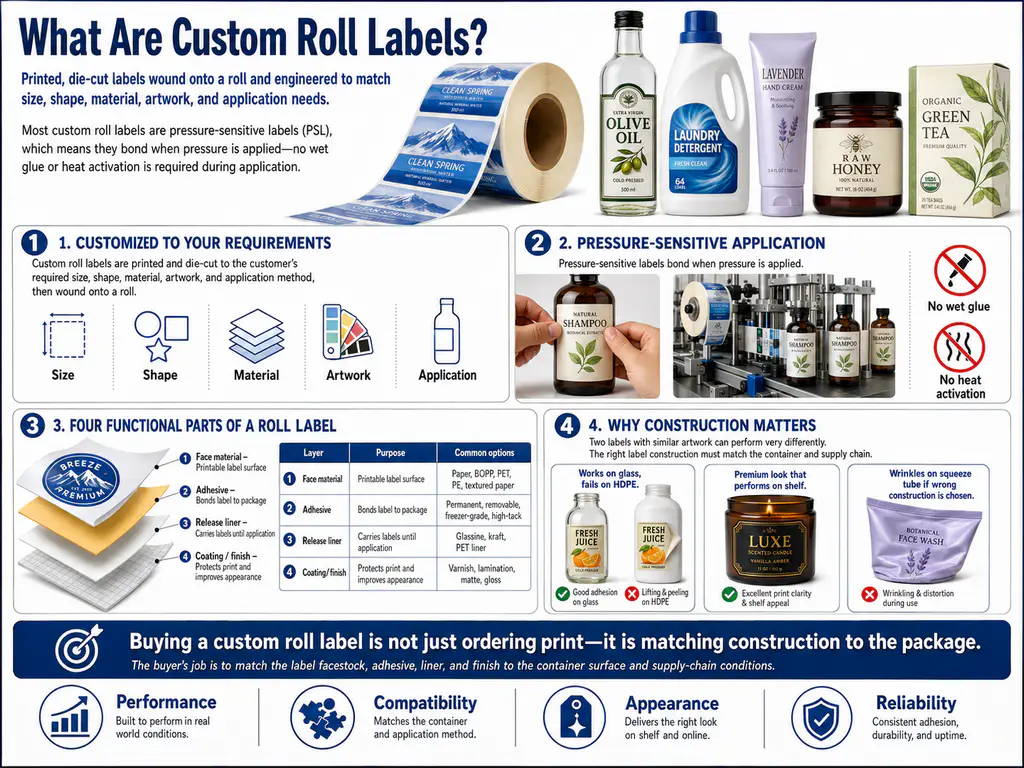
Custom roll labels are printed and die-cut to a customer’s required size, shape, material, artwork, and application needs, then wound onto a roll. Most are pressure-sensitive labels, which means they bond to a surface when pressure is applied. No wet glue or heat activation is needed during application.
A typical roll label has four functional parts:
| Layer | Purpose | Common options |
|---|---|---|
| Face material | Printable label surface | Paper, BOPP, PET, PE, textured paper |
| Adhesive | Bonds label to package | Permanent, removable, freezer-grade, high-tack |
| Release liner | Carries labels until application | Glassine, kraft, PET liner |
| Coating/finish | Protects print and improves appearance | Varnish, lamination, matte, gloss |
This structure is why two labels with similar artwork can perform differently. One may stick well to glass but fail on HDPE. Another may look premium on a shelf but wrinkle on a squeezable tube. The buyer’s job is not just to order a printed label. It is to match the label construction to the container and supply chain.
Why Roll Labels Work Better at Scale
Roll labels are the practical choice for repeated packaging work. They feed smoothly through hand dispensers, semi-automatic labelers, and high-speed automatic machines. Operators can apply labels faster, maintain more consistent placement, and reduce handling compared with loose sheets.
Rolls are also easier to manage in a factory or warehouse. Teams can store them by SKU, batch, core size, and roll quantity. Procurement teams can specify roll direction for each labeling line. Printers can control die-cutting, spacing, and rewinding so the finished roll is ready for production, not just visually correct.
Sheet labels still make sense for office use, prototypes, or very small batches. But once a brand repeats the same label across hundreds or thousands of containers, custom roll labels usually provide better speed, consistency, and cost control.
Roll Labels vs Sheet Labels
| Factor | Custom roll labels | Sheet labels |
|---|---|---|
| Best use | Medium to high-volume packaging | Small batches and office use |
| Application | Hand, dispenser, semi-auto, automatic | Mostly hand application |
| Machine compatibility | Strong | Limited |
| Storage | Compact by roll and SKU | Requires flat storage |
| Cost at scale | Usually better | Usually higher per label |
If your team is already packing products daily, roll labels are normally the more professional format.
Choosing the Right Label Material
The face material affects print quality, durability, stiffness, moisture resistance, and how the package feels in the customer’s hand.
Paper roll labels are cost-effective and print beautifully. They work well for dry goods, cartons, candles, jars, and natural-looking retail packaging. Semi-gloss paper is common for general product labels. Textured paper is often used for wine, premium food, and gift packaging.
BOPP roll labels are popular when brands need water resistance, oil resistance, and a clean retail look. White BOPP is widely used for cosmetics, food jars, beverages, and personal care products. Clear BOPP is useful for a “no-label look” on transparent containers.
PET roll labels offer stronger dimensional stability and durability. They are often used for electronics, industrial products, warning labels, and applications that need better resistance to heat, abrasion, or deformation.
PE roll labels are flexible. They are a better match for squeezable tubes and containers that bend during use. A stiff label on a flexible package may crease or lift.
If the product will face moisture, refrigeration, ice buckets, oils, or repeated handling, compare the material with Jumelage’s guide to waterproof labels for bottles. For a wider view of packaging structures, read the self-adhesive packaging materials guide.
Adhesive Selection
Adhesive should be selected according to the surface, application temperature, and storage environment. A general permanent acrylic adhesive may work well on clean glass or coated paperboard, but rough cartons, recycled cardboard, chilled bottles, or low-surface-energy plastics may need a different solution.
Common options include:
- Permanent adhesive: General product packaging, bottles, cartons, and retail labels.
- High-tack adhesive: Rough, recycled, or uneven surfaces.
- Removable adhesive: Promotional labels, temporary instructions, and reusable containers.
- Freezer-grade adhesive: Frozen food, cold storage, and refrigerated logistics.
- Wash-off adhesive: Returnable bottles or recycling-focused packaging systems.
For the technical foundation, see Jumelage’s guide to pressure-sensitive vs self-adhesive labels and the engineering article on pressure-sensitive adhesive formulations.
Roll Specifications Buyers Must Confirm
A complete custom roll label request should include more than size and artwork. Before production, confirm:
- Label width, height, shape, and corner radius
- Gap between labels
- Core diameter, usually 1 inch or 3 inches
- Maximum outside roll diameter
- Labels per roll
- Roll unwind direction
- Label orientation on the roll
- Liner material and thickness
- Application method: hand, dispenser, semi-auto, automatic
- Container surface: glass, PET, HDPE, PP, paperboard, metal, or flexible film
- Application temperature and service temperature
Roll direction is especially important for automatic labelers. If the label is wound in the wrong direction, the roll may need rewinding before it can run. For production teams, artwork approval is not the same as roll approval.
Printing and Finishing Options
Custom roll labels can be produced by digital printing, flexographic printing, thermal transfer printing, or hybrid methods. Digital printing is efficient for short runs, frequent artwork changes, and multiple SKUs. Flexographic printing is often better for high-volume repeat orders. Thermal transfer printing is common for barcode, batch, logistics, and inventory labels.
| Finish | Best for | Notes |
|---|---|---|
| Gloss varnish | Bright retail graphics | Economical print protection |
| Matte varnish | Premium or natural look | Reduces glare |
| Lamination | Moisture and abrasion resistance | Useful for handling-heavy products |
| Foil stamping | Cosmetics, wine, gifts | Premium effect with longer setup |
| Perforation | Easy separation | Useful for hand application |
For barcode-heavy labels, buyers should plan barcode size, contrast, and quiet zones early. GS1 maintains widely used barcode standards for retail and supply chains. If labels are used for food packaging, regulatory expectations also matter; the U.S. FDA provides guidance on food labeling and nutrition.
Common Applications
Custom roll labels are used for cosmetic bottles, food jars, beverage bottles, candles, supplements, pharmaceutical packaging, barcode labels, shipping labels, industrial warnings, and promotional stickers.
Each application has a different risk. Cosmetics may face oils, water, and curved containers. Food labels may need refrigeration performance and reliable barcode scanning. Industrial labels may need resistance to abrasion, heat, solvent, or outdoor exposure. Medical and pharmaceutical labels may require stricter batch control and documentation.
For brands moving toward responsible packaging, material selection can also include recycled paper, FSC paper, wash-off adhesives, liner reduction, and recyclable films. Jumelage’s article on sustainable self-adhesive materials gives additional options.
Ordering Checklist
Before approving mass production, treat the first order as an application test, not only a print test:
- Define the container material and shape.
- Confirm labeling equipment and roll direction.
- Choose material and adhesive based on the surface and environment.
- Confirm core size, roll diameter, and label spacing.
- Test labels on real containers for 24 to 72 hours.
- Check edge lifting, wrinkling, scuffing, moisture exposure, and barcode scanning.
- Approve production only after the roll works in real handling conditions.
For brands moving toward responsible packaging, material selection can also include recycled paper, FSC paper, wash-off adhesives, liner reduction, and recyclable films. Jumelage’s article on sustainable self-adhesive materials gives additional options.
FAQ
Are custom roll labels waterproof?
They can be. Waterproof performance depends on the face material, adhesive, ink, and finish. BOPP and PET labels with suitable adhesive and lamination are common choices for wet environments.
What is the best material for custom roll labels?
There is no single best material. Paper is good for dry retail packaging, BOPP is strong for moisture resistance, PET is useful for durability, and PE is better for flexible containers.
Can custom roll labels be used with automatic labeling machines?
Yes. Roll labels are commonly used with automatic and semi-automatic labeling machines, but buyers must confirm core size, outside roll diameter, unwind direction, label gap, and liner strength.
How do I prevent roll labels from peeling off?
Match the adhesive to the surface, clean the container before application, apply at the correct temperature, avoid sharp curves where possible, and test labels under real storage and shipping conditions.
Securing Your 2026 Packaging Strategy
Explore our Complete Catalog of Self-Adhesive Materials or contact our engineering team today for a custom Roll Label Specification Audit.
