
Industrial Adhesive Materials
Labels for Metal Surfaces: Adhesive, Film, and Surface Preparation Guide
Labels for metal surfaces must do more than stick on day one. They need to stay bonded, readable, and scannable on stainless steel, aluminum, painted metal, powder-coated machinery, oily housings, curved panels, and outdoor equipment.
Metal Surface Adhesion Review
Send your metal type, coating, exposure, and label purpose. Jumelage can help match film, adhesive, print protection, and testing before production.
PET
Default film choice for long-life equipment, barcode, and asset labels.
24h
Minimum dwell window before meaningful peel and edge-lift review.
UL
Testing path for permanence-sensitive product marking applications.
AI Overviews Answer
The best labels for metal surfaces usually use PET film, an industrial acrylic adhesive, durable thermal transfer or UV-printed graphics, and a protective laminate when abrasion, oil, chemicals, or outdoor exposure are expected. Stainless steel and smooth aluminum are easier to label than powder-coated, oily, curved, or textured metal. Always clean the surface, test adhesion after 24-72 hours, and validate the label under the actual temperature, chemical, and abrasion conditions.
Specification Matrix
Match the label construction to the actual metal surface
Stainless steel
PET film + acrylic adhesive + resin ribbon. Risk: fingerprints, oil film, passivation residue. Test: peel after cleaning and dwell.
Anodized aluminum
PET or metalized film + durable adhesive. Risk: texture and porosity variation. Test: adhesion and abrasion.
Painted metal
PET film + compatible permanent or removable adhesive. Risk: paint damage during removal. Test: peel and removal.
Powder-coated metal
High-tack adhesive + conformable film. Risk: texture reduces adhesive contact area. Test: edge lift after dwell.
Oily machinery
Oil-resistant adhesive + laminate. Risk: adhesive softening and print staining. Test: oil wipe and barcode scan.
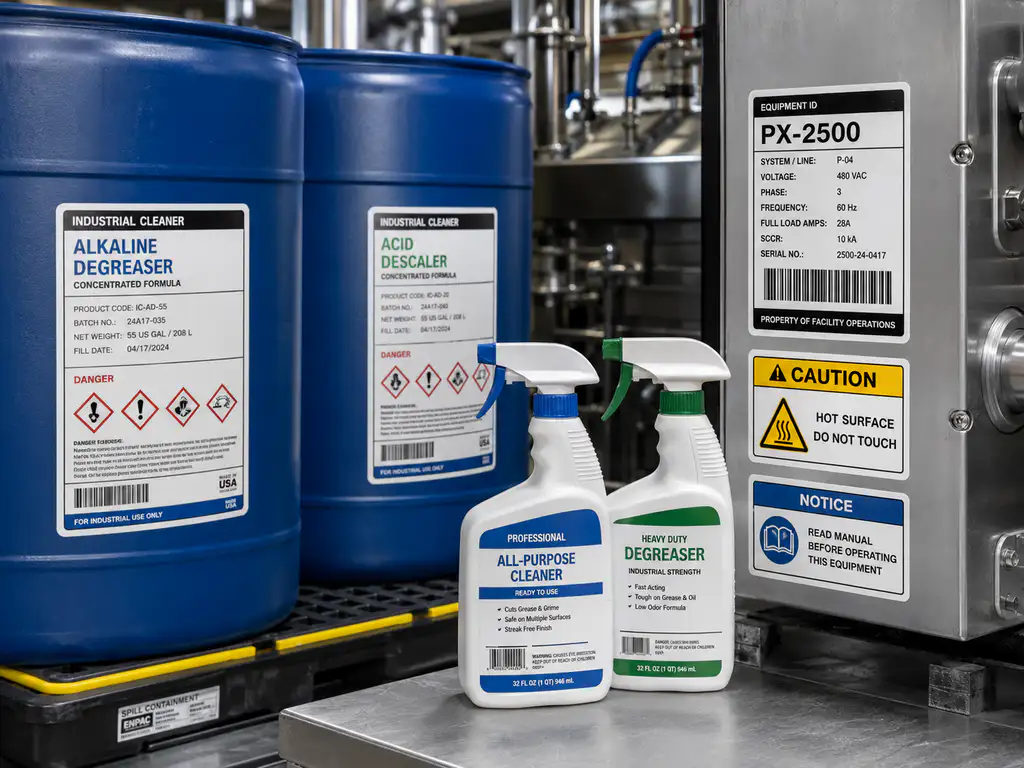
Material Compatibility
Different metal finishes need different label behavior
Stainless steel and anodized aluminum
Smoother surfaces often bond well, but fingerprints, lubricants, polishing residue, passivation residue, porosity, or texture can still reduce adhesion.
Painted and powder-coated metal
Painted metal requires removal testing when coating damage matters. Powder coat often needs high-tack adhesive, pressure, rounded corners, and dwell validation.
Film selection
PET film is the default starting point for long-life industrial labels. BOPP or PP can suit mild indoor use, while polyimide fits very high-temperature conditions.
Adhesive Selection
Choose adhesive by contamination, temperature, and coating risk
Adhesive selection is the performance core of labels for metal surfaces. Film and print quality matter, but the adhesive decides whether the label survives real metal conditions.
Acrylic adhesive
Often the first recommendation for durable film labels because it supports UV stability, aging resistance, temperature performance, and equipment labeling.
Rubber or high-tack adhesive
Useful where high initial tack is needed, especially on indoor or textured surfaces, but usually weaker under heat, UV, oils, and aggressive cleaners.
Specialty adhesive
Silicone, low-temperature, oil-resistant, or removable adhesives should be selected when the application profile clearly requires them.
Installation Process
Surface preparation is where most metal label failures begin
Poor preparation creates a barrier between adhesive and metal. Dust, oil, oxidation, fingerprints, moisture, and cleaner residue can all cause edge lift or early failure.
1. Identify
Identify metal and coating.
2. Remove
Remove dust, oil, grease, fingerprints, and oxidation.
3. Clean
Use approved cleaner such as isopropyl alcohol where suitable.
4. Dry
Allow the surface to dry completely.
5. Apply
Apply within the recommended temperature range.
6. Press
Use firm pressure with a roller or squeegee.
7. Test
Allow 24-72 hours dwell before final testing.
Testing & Standards
Turn "durable" into measurable exposure
For labels for metal surfaces, durability should be translated into temperature, UV, abrasion, oil, chemical wipe, humidity, salt spray, and expected years of use.
Adhesion and edge-lift
Test peel after 24 and 72 hours, then review vertical shear and edge-lift on the actual metal part.
Print and barcode survival
Run abrasion, oil wipe, degreaser, and scan tests when labels carry serial numbers, QR codes, or warning text.
Outdoor and thermal stress
Use UV/weathering and thermal cycling tests for outdoor assets or hot machinery. For elevated temperatures, see the high temperature labels guide.
RFQ Checklist
Send these details for faster material matching
- Metal type: stainless steel, aluminum, bare steel, painted metal, powder coat, plated metal, or unknown.
- Surface finish: smooth, brushed, textured, oily, curved, rough, or coated.
- Application temperature and service-temperature range.
- Exposure: UV, outdoor weather, oil, coolant, detergent, solvent, salt spray, abrasion, or heat.
- Label purpose: barcode, equipment ID, warning label, panel marking, asset tag, or nameplate substitute.
- Print method: blank, thermal transfer, digital, UV, screen, or preprinted roll.
- Required life: temporary, months, 1-3 years, 5+ years, or permanent.
- Removal requirement: permanent, removable, clean-removable, or mechanically mounted.
- Compliance or customer test requirement: UL 969, ASTM reference, internal test report, or approval sample.
FAQ
Questions engineers ask before approving metal labels
What are the best labels for metal surfaces?
For most industrial applications, PET film labels with acrylic adhesive and resin thermal transfer or durable printed graphics are the strongest starting point. Add a laminate when abrasion, oil, chemical wipe, or outdoor exposure is expected.
What adhesive sticks best to stainless steel?
Industrial acrylic adhesives usually work well on clean stainless steel. The surface should be degreased and dried before application because fingerprints, polishing residue, and oils can reduce adhesion.
Do labels stick to powder-coated metal?
Yes, but powder-coated metal is more difficult than smooth stainless steel or aluminum. Its texture reduces contact area, so high-tack adhesive, firm pressure, rounded label corners, and dwell testing are recommended.
How should metal be cleaned before applying labels?
Remove dust, oil, grease, fingerprints, and loose oxidation. Where suitable, clean with isopropyl alcohol and allow the surface to dry fully before applying pressure. Always confirm cleaner compatibility with painted or coated metal.
Can labels for metal surfaces survive oil, solvents, and outdoor exposure?
They can, if the film, adhesive, print system, and laminate are selected for those exposures. Oil, solvent, UV, abrasion, and heat should be tested on the actual metal surface before production.
When should I choose a metal nameplate instead of an adhesive label?
Choose a metal nameplate, engraving, or mechanical mounting when the marking must survive extreme heat, heavy mechanical abrasion, severe impact, or very long outdoor service where adhesive labels may not be enough.
How do I remove labels from painted metal without damaging the coating?
Use controlled heat, a plastic scraper, and a paint-compatible adhesive remover. Test in a small area first. If future removal is expected, specify removable adhesive before ordering.
Securing Your 2026 Metal Labeling Strategy
Choosing labels for metal surfaces is about matching film, adhesive, print protection, and surface preparation to the actual metal finish and service environment. Jumelage can help test materials on stainless steel, aluminum, painted metal, powder-coated equipment, and oily machinery surfaces before production.
Explore our Complete Catalog of Self-Adhesive Materials or contact our engineering team today for a custom Metal Surface Adhesion Review.
