
Table of Contents
Custom industrial labels are pressure-sensitive labels engineered for equipment, machines, tools, components, cartons, drums, control panels, plastic parts, and outdoor assets. Unlike standard product stickers, they must stay readable and bonded through abrasion, chemicals, oil, heat, moisture, UV exposure, cleaning, vibration, and long service life.
The best custom industrial labels are specified as a complete system: face material, adhesive, ink, coating or laminate, surface type, application temperature, and exposure conditions. A label for a powder-coated machine frame needs a different construction from a label for a smooth PET container, rough casting, oily metal part, or outdoor electrical enclosure.
For buyers comparing roll format, liner, core size, and application setup, Jumelage’s guide to custom roll labels is a useful starting point. This article focuses on industrial durability and how to choose label materials that survive real working environments.
High temperature labels are essential for maintaining traceability in 2026’s extreme industrial environments. In the high-precision world of electronics…
What Are Custom Industrial Labels?
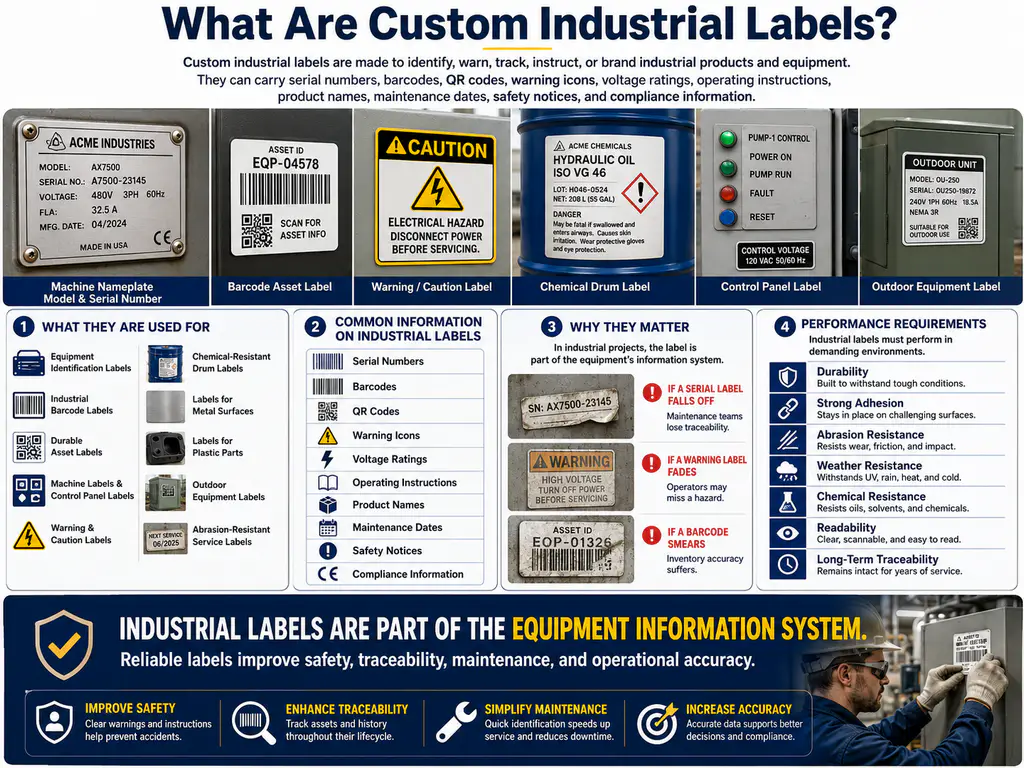
Custom industrial labels are made to identify, warn, track, instruct, or brand industrial products and equipment. They can carry serial numbers, barcodes, QR codes, warning icons, voltage ratings, operating instructions, product names, maintenance dates, safety notices, or compliance information.
Common applications include:
- Equipment identification labels
- Industrial barcode labels
- Durable asset labels
- Machine labels and control panel labels
- Warning and caution labels
- Chemical-resistant drum labels
- Labels for metal surfaces
- Labels for plastic parts
- Outdoor equipment labels
- Abrasion-resistant service labels
In many industrial projects, the label is not decorative. It is part of the equipment’s information system. If a serial label falls off, a maintenance team may lose traceability. If a warning label fades, operators may miss a hazard. If a barcode smears, inventory accuracy suffers.
Why Industrial Labels Fail
Most industrial label failures come from a mismatch between the label system and the environment. The artwork may be correct, but the construction is wrong.
| Failure | Common cause | Better specification |
|---|---|---|
| Edge lifting | Low adhesive contact, rough surface, tight curve | Higher-tack adhesive, flexible film, surface cleaning |
| Fading | UV exposure, heat, chemical cleaning | UV-resistant ink, PET film, protective laminate |
| Smearing | Wrong print method or ribbon | Thermal transfer resin ribbon, overlaminate |
| Peeling from plastic | Low-surface-energy PP or PE | LSE-compatible adhesive |
| Barcode scan failure | Abrasion, low contrast, wrinkles | Durable film, correct barcode size, scan testing |
| Residue after removal | Wrong adhesive for temporary use | Removable adhesive or clean-release construction |
This is why sampling matters. A label should be tested on the real surface, at the real application temperature, after cleaning and handling, not only inspected on a proof sheet.
Choosing the Right Face Material
Face material controls the label’s appearance, stiffness, printability, and durability.
PET labels are often the first choice for durable industrial applications. PET offers strong dimensional stability and better resistance to heat, abrasion, moisture, and handling than basic paper. It is widely used for equipment ID labels, electronics, appliance markings, control panels, and industrial barcode labels.
BOPP labels are useful when moisture resistance and a clean film look are needed, but the environment is not extremely harsh. BOPP can work well for containers, packaged components, storage bins, and some chemical or cosmetic-industrial crossovers.
Vinyl/PVC labels are flexible and can conform to curved or irregular surfaces. They are often used for outdoor warning labels, pipe labels, and flexible equipment marking. Buyers should confirm environmental and regulatory preferences before choosing PVC.
Synthetic paper labels can be a middle ground between paper and film. They are useful where tear resistance and moisture resistance are needed but the label does not require full heavy-duty PET performance.
Paper industrial labels still have a place on cartons, warehouse bins, short-life work-in-process tracking, and dry indoor applications. They are usually not the best choice for chemical exposure, outdoor equipment, or long-term asset identification.
For labels exposed to heat, compare the application with Jumelage’s guide to high temperature labels. For wet industrial environments, buyers should also test moisture exposure, edge lift, and film selection on the real surface before approving production.
Adhesive Selection by Surface
Adhesive is often the most important part of custom industrial labels. The same label face can perform very differently on smooth stainless steel, powder-coated metal, HDPE, ABS, rough cardboard, textured plastic, or painted equipment.
| Surface | Adhesive direction | Practical note |
|---|---|---|
| Smooth metal | Permanent acrylic adhesive | Clean oil and dust before application |
| Powder-coated metal | High-tack or surface-specific adhesive | Texture reduces contact area |
| PP/PE plastic | Low-surface-energy adhesive | Standard adhesive may lift |
| ABS/PC plastic | Permanent acrylic or film adhesive | Test for plasticizer or coating issues |
| Rough surfaces | High-tack adhesive | More adhesive flow improves contact |
| Outdoor equipment | UV/moisture-resistant system | Face, ink, adhesive, and laminate all matter |
| Chemical drums | Chemical-resistant adhesive and film | Test against actual chemical exposure |
For the engineering background, Jumelage’s guide to pressure-sensitive adhesive formulations explains tack, peel, shear, aging, and environmental resistance. Industrial buyers should treat adhesive selection as a performance requirement, not an afterthought.
Durability Requirements to Define Before Ordering
Before producing custom industrial labels, define the conditions the label must survive:
- Indoor or outdoor use
- Expected service life
- Application surface and surface energy
- Application temperature
- Operating temperature range
- Chemical, oil, solvent, or cleaner exposure
- UV exposure and weathering
- Abrasion from hands, tools, pallets, or cleaning
- Curved or flat surface
- Barcode or QR code scanning distance
- Permanent, removable, or tamper-evident requirement
For safety and hazard labels, content requirements may also matter. OSHA’s Hazard Communication Standard requires labels for hazardous chemicals to include harmonized elements such as signal words, pictograms, hazard statements, and precautionary statements in covered situations. See OSHA’s Hazard Communication overview and 29 CFR 1910.1200 for official guidance.
For durable product markings, UL 969 is often referenced in industry because it covers marking and labeling systems used as permanent nameplates or markers. UL’s public description of Marking and Labeling Systems notes that these labels can be adhesive-attached and used for information, instructions, or identification. If your project requires certified performance, confirm the exact standard, construction, and test conditions with your compliance team.
Printing and Protection Options
The print method must match the label’s service life.
Thermal transfer printing is common for serial numbers, barcodes, variable data, and asset labels. Resin ribbons are often used with PET films for better abrasion and chemical resistance. Jumelage’s guide to thermal transfer labels explains ribbon selection in more detail.
Digital printing works well for short runs, multiple SKUs, and color labels. It is useful when buyers need many warning variants, equipment families, or localized labels without high plate costs.
Screen printing or specialty printing may be selected for very durable graphics, warning panels, or harsh environments, depending on the construction and volume.
Protection options include gloss or matte varnish, clear PET laminate, UV-resistant laminate, and chemical-resistant overlaminate. For industrial labels, laminate is not only a cosmetic finish. It can protect barcodes, warning text, and serial numbers from abrasion and cleaners.
Barcode and Asset Tracking Considerations
Industrial barcode labels must be readable after application and use, not just immediately after printing. Barcode contrast, quiet zones, label curvature, laminate glare, print resolution, and abrasion all affect scanning.
The global standards organization GS1 maintains barcode standards used across supply chains. For industrial users, barcode verification should be part of the sample test. Apply the label to the real part, rub it, clean it if relevant, expose it to expected conditions, and scan it again.
For security-sensitive applications, pair durable materials with tamper-evident constructions. Jumelage’s article on security barcode labels is a better fit when the label must show evidence of removal or protect asset integrity.
Ordering Checklist
Before requesting a quote for custom industrial labels, prepare:
- Label size and shape.
- Application surface: metal, plastic, powder coat, glass, cardboard, or painted part.
- Surface condition: smooth, rough, oily, curved, textured, or dusty.
- Indoor or outdoor use.
- Temperature range.
- Chemical, oil, solvent, or cleaner exposure.
- Required service life.
- Print type: fixed artwork, barcode, serial number, QR code, or variable data.
- Durability need: UV, abrasion, moisture, heat, chemical, or tamper evidence.
- Roll format, core size, and application method.
- Compliance or customer standard requirements.
- Sample testing plan.
This checklist prevents a common mistake: choosing labels by material name alone. “PET label” or “strong adhesive” is not a full specification. Industrial performance comes from the whole label system.
Visual Assets to Add
Recommended visuals for the published page:
- Photo of custom industrial labels on metal equipment and plastic parts
- Surface compatibility chart: metal, PP/PE, ABS, powder coat, rough surfaces
- Durability matrix: UV, chemical, oil, abrasion, heat, moisture
- Diagram showing face film, adhesive, liner, print, and laminate
- Downloadable “Industrial Label Specification Sheet”
These visuals help engineering and procurement teams explain their label environment before requesting samples.
FAQ
What are custom industrial labels used for?
Custom industrial labels are used for equipment identification, warning labels, barcode tracking, machine labels, asset tags, chemical containers, control panels, plastic parts, metal surfaces, and outdoor durable marking.
What material is best for custom industrial labels?
PET is often the best starting point for durable equipment and asset labels. BOPP, vinyl, synthetic paper, and paper can also work depending on exposure, surface, flexibility, print method, and required service life.
What adhesive works best on metal surfaces?
Smooth metal often works with a permanent acrylic adhesive after cleaning. Powder-coated or rough metal may need a higher-tack adhesive because the textured coating reduces contact area.
Can custom industrial labels stick to plastic parts?
Yes, but PP and PE plastics often need a low-surface-energy adhesive. ABS, PC, and coated plastics should still be tested because surface treatments and plasticizers can affect adhesion.
How do I make industrial labels last outdoors?
Use a durable film such as PET or vinyl, pair it with a weather-resistant adhesive, protect the print with a UV-resistant laminate, and test the label on the real surface under expected conditions.
Securing Your 2026 Industrial Labeling Strategy
Specifying custom industrial labels is about protecting the information your equipment, operators, and maintenance teams depend on. By matching face material, adhesive chemistry, print method, and durability testing to the real surface and environment, Jumelage helps your labels stay readable, bonded, and useful through demanding industrial conditions.
Explore our Complete Catalog of Self-Adhesive Materials or contact our engineering team today for a custom Industrial Label Material Compatibility Review.
