
Table of Contents
Thermal transfer labels are labels printed by using heat to transfer ink from a ribbon onto the label surface. Unlike direct thermal labels, which darken through a heat-sensitive coating, thermal transfer labels use a separate ribbon. That makes them a better choice when the label must stay readable through handling, storage, abrasion, moisture, sunlight, refrigeration, or chemical exposure.
For B2B buyers, the important decision is not simply “thermal transfer or direct thermal.” The real question is: what label material, ribbon type, adhesive, and print environment will keep the barcode or product information readable for the required service life?
If you are comparing label formats before choosing a printer setup, Jumelage’s guide to custom roll labels explains roll direction, core size, liner, and machine application details. This article focuses on the printable thermal transfer construction and how to specify it correctly.
High temperature labels are essential for maintaining traceability in 2026’s extreme industrial environments. In the high-precision world of electronics…
What Are Thermal Transfer Labels?
Thermal transfer labels are pressure-sensitive labels designed for thermal transfer printing. During printing, the printhead heats selected dots on a ribbon. The ribbon coating melts or transfers onto the label surface, creating text, barcodes, QR codes, batch numbers, graphics, or variable data.
This process is different from direct thermal printing. Wikipedia’s overview of thermal printing notes that direct thermal printing uses heat-sensitive paper, while thermal transfer printing uses a heat-sensitive ribbon with plain paper or another substrate. In practical packaging terms, that difference changes durability, cost, printer setup, and label material selection.
Thermal transfer labels are common in:
- Warehouse and inventory labels
- Shipping and logistics labels
- Product identification labels
- Food and beverage packaging
- Pharmaceutical and medical packaging
- Electronics and appliance labels
- Chemical drum and industrial warning labels
- Outdoor asset and equipment labels
They are especially valuable when the printed information must remain scannable. A faded product logo is a branding problem. A faded barcode, serial number, or compliance label can become an operational problem.
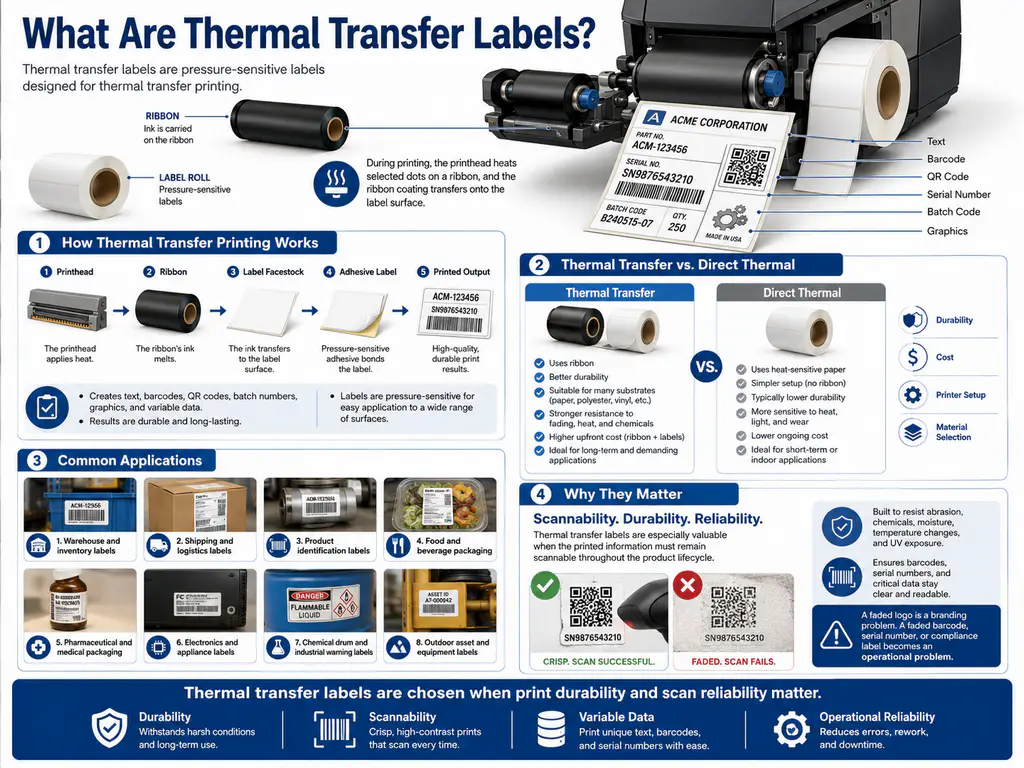
Thermal Transfer vs Direct Thermal Labels
Both technologies use heat, but they are not interchangeable.
| Factor | Thermal transfer labels | Direct thermal labels |
|---|---|---|
| Printing method | Heat transfers ink from ribbon | Heat activates coating on label |
| Ribbon required | Yes | No |
| Durability | Medium to very high | Short to medium |
| Best for | Barcodes, product ID, warehouse, industrial use | Receipts, short-life shipping, temporary labels |
| Resistance | Better abrasion, heat, light, chemicals with right material | More sensitive to heat, light, friction |
| Cost structure | Label plus ribbon | Label only |
Direct thermal labels are convenient for short-life applications. Thermal transfer labels are better when the label must survive longer or remain readable in tougher environments. For industrial buyers, the specification should focus on service life, barcode readability, ribbon compatibility, and exposure conditions rather than printer convenience alone.
Choosing the Right Label Material
The label face material determines how well the printed image bonds and how the label performs in the field.
Thermal transfer paper labels are economical and widely used for cartons, inventory, warehouse bins, dry product packaging, and general barcode labels. They are a good choice when the environment is clean, dry, and not highly abrasive.
BOPP thermal transfer labels offer better moisture and oil resistance than paper. They are common for food jars, cosmetics, personal care packaging, refrigerated products, and labels that need a cleaner film appearance.
PET thermal transfer labels are used when durability matters. PET has better dimensional stability and is often selected for electronics, appliances, industrial equipment, warning labels, and labels exposed to handling or higher stress.
Synthetic thermal transfer labels are useful when paper is not enough but full industrial PET may be more than the application needs. The goal is to match the material to the actual exposure, not to over-specify every job.
If the label will face water, condensation, ice buckets, or refrigeration, compare your choice with Jumelage’s guide to waterproof labels for bottles. If it will face heat, ovens, electronics, or industrial process temperatures, review the guide to high temperature labels.
Ribbon Selection: Wax, Wax-Resin, or Resin
Ribbon choice is where many thermal transfer projects succeed or fail. A strong label material with the wrong ribbon can still smear, scratch, or scan poorly.
| Ribbon type | Best match | Typical use | Tradeoff |
|---|---|---|---|
| Wax | Paper labels | Shipping, cartons, general warehouse | Lowest cost, lower abrasion resistance |
| Wax-resin | Coated paper, BOPP, some synthetics | Product labels, retail, logistics | Balanced durability and cost |
| Resin | PET, durable films, harsh environments | Chemical, electronics, outdoor, industrial labels | Highest durability, higher cost |
Wax ribbons are cost-effective for standard paper barcode labels. Wax-resin ribbons improve smudge and scratch resistance. Resin ribbons are selected for tougher film labels where resistance to abrasion, chemicals, heat, or moisture is important.
The ribbon should also match the printer’s printhead, speed, darkness setting, and label surface. If the barcode looks dark but fails a scanner test after abrasion, the problem may be the ribbon-material pairing, not the barcode file.
Adhesive Selection for Thermal Transfer Labels
The adhesive must be chosen for the surface and environment. Common options include:
- General permanent adhesive: Cartons, coated paperboard, glass, and common packaging surfaces.
- High-tack adhesive: Rough cardboard, recycled cartons, drums, textured surfaces, and low-energy plastics.
- Freezer-grade adhesive: Frozen food, cold chain storage, and refrigerated warehouses.
- Removable adhesive: Temporary instructions, reusable containers, and promotional labels.
- Chemical-resistant constructions: Drum labels, lab labels, industrial chemicals, oils, and cleaners.
For more detail on adhesive behavior, Jumelage’s engineering guide to pressure-sensitive adhesive formulations explains how adhesive chemistry affects tack, peel, shear, aging, and environmental resistance.
Barcode Readability and Compliance
Thermal transfer labels are often used because barcodes must scan reliably. Buyers should define the barcode type, size, contrast, quiet zone, printer resolution, and inspection method before mass production.
The global standards body GS1 publishes barcode standards used across retail, logistics, and supply chains. For regulated products, labeling rules may also apply. Food packaging teams, for example, should review the U.S. FDA’s food labeling and nutrition resources before finalizing mandatory information.
In production, a barcode should be tested after the label has been applied, not only after printing. Curved bottles, rough cartons, low contrast, ribbon smudge, laminate glare, and label wrinkles can all reduce scan reliability.
Common Applications
Thermal transfer labels are a practical choice when variable data and durability meet. In warehouses, they identify bins, pallets, cartons, and returnable assets. In manufacturing, they carry batch numbers, work-in-process data, warnings, and product IDs. In retail packaging, they support SKU labels, ingredient stickers, and traceability codes. In healthcare and pharmaceuticals, they support lot control and inventory accuracy.
For brands moving toward responsible packaging, material selection can also include recycled paper, FSC paper, wash-off adhesives, liner reduction, and recyclable films. Jumelage’s article on sustainable self-adhesive materials gives additional options.
Ordering Checklist
Before ordering thermal transfer labels, confirm:
- Printer model and printhead resolution.
- Label width, height, gap, core size, and roll direction.
- Face material: paper, BOPP, PET, or another synthetic.
- Ribbon type: wax, wax-resin, or resin.
- Application surface and surface cleanliness.
- Application temperature and service temperature.
- Exposure to water, oil, chemicals, abrasion, sunlight, or freezing.
- Barcode type, size, scanner distance, and verification method.
- Required label life: days, months, years, or permanent identification.
- Sample testing on real containers or cartons before mass production.
This checklist prevents the most common buying mistake: approving a label based on print appearance alone. A thermal transfer label should be judged by application, scan performance, and durability.
FAQ
What are thermal transfer labels used for?
They can be. Waterproof performance depends on the face material, adhesive, ink, and finish. BOPP and PET labels with suitable adhesive and lamination are common choices for wet environments.
Are thermal transfer labels waterproof?
They can be waterproof when made with film materials such as BOPP or PET, paired with the right adhesive and ribbon. Paper thermal transfer labels are usually not the best choice for wet environments.
What ribbon should I use for thermal transfer labels?
Use wax ribbon for standard paper labels, wax-resin for better durability on coated paper or films, and resin ribbon for PET or harsh industrial environments.
Are thermal transfer labels better than direct thermal labels?
They are better for long-term readability and tougher environments. Direct thermal labels are simpler and ribbon-free, but they are more sensitive to heat, light, friction, and aging.
Are thermal transfer labels better than direct thermal labels?
Smudging usually comes from the wrong ribbon-material match, insufficient print heat, excessive print speed, dirty printhead, or a label surface that is not compatible with the ribbon.
Securing Your 2026 Labeling Strategy
Specifying thermal transfer labels is about protecting the information your operation depends on: barcodes, batch codes, product IDs, warning text, and traceability data. By matching face material, ribbon chemistry, adhesive, and application conditions, Jumelage helps your labels stay readable from printing to final use.
Explore our Complete Catalog of Self-Adhesive Materials or contact our engineering team today for a custom Thermal Transfer Label Compatibility Review.
