
Table of Contents
Tamper evident labels are self-adhesive security labels designed to show visible, irreversible evidence when someone tries to remove, open, or alter a product, package, seal, or asset. Common options include VOID labels, destructible vinyl labels, tamper-evident seals, holographic labels, and security barcode labels. For packaging, electronics, pharmaceuticals, cosmetics, food, and warranty protection, the right label depends on surface material, adhesive strength, removal evidence, print method, and compliance requirements.
At Jumelage, our China-France joint venture heritage and 35,000㎡ GMP-certified facility allow us to engineer high-security materials that meet international standards. To successfully deploy tamper evident labels, procurement specialists must understand the delicate balance between film embrittlement, release-force differentials, and adhesive shear strength. This 2026 guide will break down the materials, mechanics, and selection criteria required to secure your product line.
High temperature labels are essential for maintaining traceability in 2026’s extreme industrial environments. In the high-precision world of electronics…
What Are Tamper Evident Labels?
Simple Definition
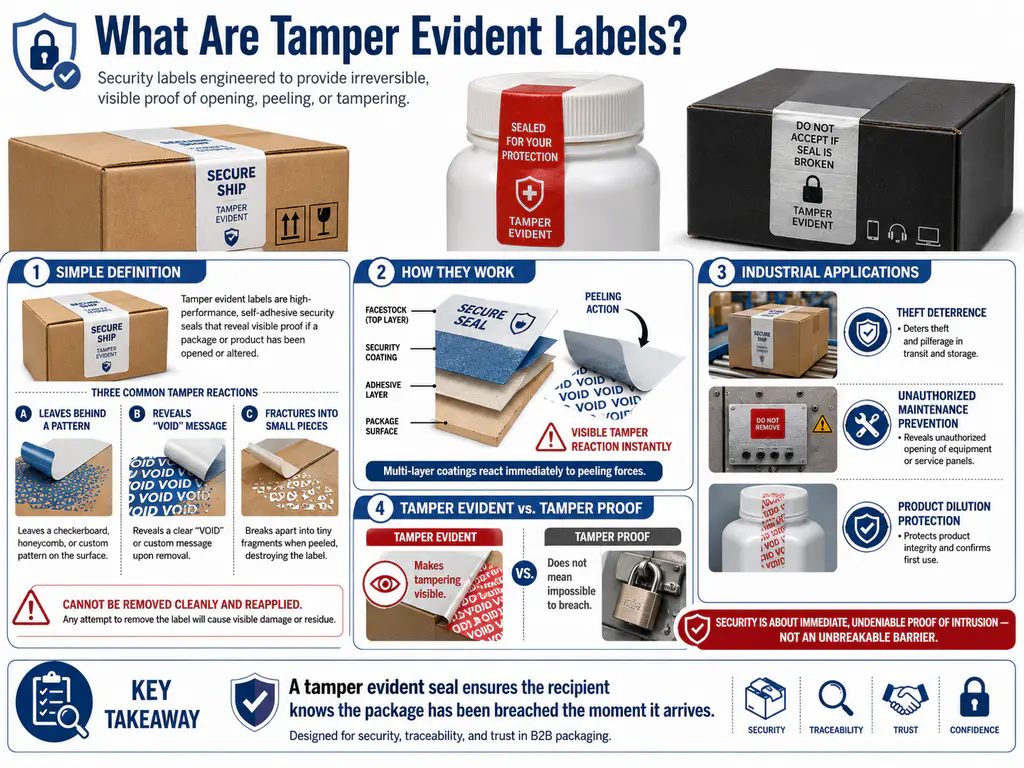
Tamper evident labels are high-performance self-adhesive security seals designed to show irreversible, visible proof if a package or product has been opened or altered. Once peeled or disturbed, these labels leave behind a pattern, a “VOID” message, or fracture into small pieces, preventing them from being cleanly removed and reapplied.
In industrial applications, these materials serve as a primary deterrent against theft, unauthorized maintenance, and product dilution. Unlike traditional paper stickers, a technical Pressure-Sensitive Label (PSL) designed for security is engineered with multi-layer coatings that react instantly to peeling forces, as detailed in our Pressure-Sensitive Adhesive (PSA) Guide.
Tamper Evident vs. Tamper Proof Labels
In B2B purchasing, it is critical to clarify that tamper evident labels do not always prevent tampering, but they make tampering visible. While marketers often use the term “tamper proof labels,” material scientists recognize that no label is 100% impenetrable. A determined thief can cut through a container, but a tamper-evident seal ensures that the recipient knows the package has been breached the moment it arrives.
This technical distinction is defined by industry leaders like Brady Corporation, who emphasize that security is about providing immediate, undeniable proof of intrusion rather than trying to build an unbreakable physical barrier. For a deeper look at terminology, see our guide: What does self-adhesive mean?.
How Do Tamper Evident Labels Work?
The mechanics of tamper evident labels depend on controlled physical failure. There are three primary mechanisms utilized in 2026 security packaging:
They Leave a VOID Message
These labels utilize a release-force differential. When a VOID Polyester Label is peeled, a hidden layer of ink separates from the carrier film. Part of the adhesive stays on the substrate, leaving a bold, irreversible “VOID” or “OPENED” message, while the peeled film itself is left with clear windows where the ink used to be. Industry standard 3M VOID label materials utilize this silicone-release chemistry to ensure reliable performance on high- and low-surface-energy substrates alike.
They Break Into Pieces (Ultra-Destructible)
Instead of leaving a message, ultra-destructible vinyl labels are engineered with extremely low tensile strength and high adhesion. Once applied, the bond between the adhesive and the substrate is stronger than the internal strength of the vinyl itself. If anyone attempts to peel the label, it immediately fractures into tiny, eggshell-like pieces, making complete removal impossible. This technology is widely used in warranty protection labels.
They Leave a Pattern or Residue
Similar to VOID labels, these security stickers leave behind a checkerboard, honeycomb, or triangle pattern upon removal. Avery Dennison’s tamper-evident asset tags utilize a checkered-pattern residue layer, ensuring that even if the top film is removed, the printed serial number or barcode remains permanently altered, preventing the label from being re-used on a different asset.
Main Types of Tamper Evident Labels
To help you navigate your security requirements, we have compiled the performance metrics of the six primary types of tamper evident labels manufactured at Jumelage.
| Type | Destruction Mechanism | Best B2B Use Case |
|---|---|---|
| **VOID Labels** | Leaves VOID/OPENED print | High-end Electronics, Warranty Seals |
| **Destructible Vinyl** | Shatters into tiny fragments | Asset Identification, Calibration Seals |
| **Tamper Evident Seals** | Tears upon lid/cap rotation | OTC Drugs, Cosmetics, Food Jars |
| **Holographic Labels** | Visual pattern change + VOID | Luxury Spirits, Certificates, Luxury Goods |
| **Barcode Security** | Serialized barcode splits | Inventory Logistics, Asset Management |
| **Perforated Labels** | Tears cleanly along laser cuts | Cardboard Cartons, Courier Envelopes |
Common Materials Used for Tamper Evident Labels
The durability and security level of your label depend entirely on its material science.
A. VOID Polyester (PET)
Polyester is highly durable, dimensionally stable, and resistant to chemicals, moisture, and high temperatures. It is the gold standard for electronics packaging and metal asset labels. When you need to print high-resolution barcodes using thermal transfer resin ribbons, VOID PET is the superior substrate.
B. Destructible Vinyl (PVC)
Unlike PET, vinyl has no “tensile memory,” making it extremely fragile. It conforms easily to curved or textured surfaces, making it the perfect choice for warranty seals on irregular parts.
C. Paper Security Labels
A cost-effective solution for short-term packaging, such as pizza box closures or courier envelopes. They tear easily along laser-perforated lines but offer limited water resistance compared to film-based alternatives. Learn about waterproof options in our Waterproof Bottle Labels Guide.
D. PET / PP Film Security Labels
Highly transphttps://www.jumelage-cn.com/waterproof-labels-for-bottles-guide/arent and water-resistant, making them ideal for premium cosmetics and beverage packaging where aesthetic integration is as important as security.
E. Holographic Film
A multi-layered film printed with microscopic laser patterns that shift colors and shapes depending on the viewing angle. It is virtually impossible to copy using standard digital printers, establishing immediate E-E-A-T (Experience, Expertise, Authoritativeness, Trustworthiness) for luxury products.
Best Applications for Tamper Evident Labels
Electronics and Warranty Protection
Modern electronics are packed with delicate components. A custom tamper evident label applied over screws or casing seams protects manufacturers from fraudulent warranty claims. If a consumer opens a router or a smartphone to attempt an unauthorized repair, the label will break or leave a VOID message, voiding the warranty instantly.
Pharmaceutical and OTC Drug Packaging
In the pharmaceutical sector, security is legally mandated. The US FDA enforces strict tamper-evident packaging regulations under 21 CFR 211.132 for over-the-counter (OTC) human drug products. For pharmaceutical and OTC drug products, label selection should be evaluated together with packaging structure, regulatory requirements, and end-use testing. Our GMP Medical Label Guide explores these stringent validation protocols.
Cosmetics, Food, and Logistics
From sealing organic face creams to securing high-speed e-commerce delivery boxes, tamper evident labels prevent product contamination, theft, and secondary sales. For frozen food or vaccine distribution, they must be paired with Cold Chain Adhesive Technology to maintain adhesion at -80°C.
How to Choose the Right Tamper Evident Label
Before placing a bulk order for tamper evident labels, your engineering team must answer five critical questions to ensure peak performance:
- What is the Surface Material? Is the surface glass, powder-coated metal, textured cardboard, or low-surface-energy (LSE) plastic like PP/PE? LSE plastics are notoriously difficult to bond to and require specialized adhesives, such as those formulated in our Custom Label Guide.
- What Evidence Type is Required? Do you want a clean peel that leaves a “VOID” message on the substrate, or do you want the label to shatter into tiny pieces?
- What is the Exposure Environment? Will the label face extreme heat (such as PCB solder reflow ovens), high humidity, outdoor UV rays, or exposure to industrial solvents?
- What is the Printing Method? Will you print variable data (barcodes, serial numbers, QR codes) on-site using Thermal Transfer printing, or do you require pre-printed flexographic labels from our factory?
- Have You Tested Samples? Never skip the testing phase. We recommend performing peel tests (following ASTM D3330) and aging tests on your specific packaging materials before bulk production.
Tamper Evident Labels vs Security Labels vs Anti-Counterfeit Labels
Many buyers confuse these terms. The table below outlines their distinct roles in brand protection.
| Label Category | Primary Purpose | Key Technical Feature |
|---|---|---|
| **Tamper Evident** | Show removal or opening | VOID print, destructible vinyl film |
| **Security** | Asset tracking & warning | Sequential serial numbers, barcode tracking |
| **Anti-Counterfeit** | Verify product authenticity | Hologram, micro-text, taggant inks |
| **Warranty** | Prevent unauthorized repair | Laser-cut perforations, extreme adhesion |
Tamper Evident Labels vs Security Labels vs Anti-Counterfeit Labels
At Jumelage, we specialize in customizing tamper evident labels to match your exact brand specifications. We can customize the label size, shape, material thickness, adhesive tack, custom VOID messages (such as your brand’s name), holographic visual patterns, and variable data tracking.
Common Procurement Mistakes to Avoid:
- Choosing the Wrong Adhesive: Applying a standard acrylic adhesive to a textured or low-surface-energy PP bottle, resulting in label lifting.
- Ignoring Surface Energy: Assuming a label that works on cardboard will behave the same way on plastic.
- Using VOID PET Where Destructible Vinyl is Better: For assets with irregular or curved surfaces, destructible vinyl provides much better conformability and tamper evidence than stiff PET.
FAQ: Common Technical Questions
- Are tamper evident labels the same as tamper proof labels? Not exactly. Tamper evident labels are designed to show visible, irreversible evidence of tampering, whereas “tamper proof” is a marketing term. No packaging is completely tamper-proof if someone has the time and tools to breach it.
- Can tamper evident labels be removed? They can be physically removed, but they are engineered to leave behind clear, undeniable proof of removal—such as leaving a sticky “VOID” message on the product, tearing along laser perforations, or fracturing into tiny pieces.
- Are tamper evident labels waterproof? Yes, film-based tamper evident labels (such as VOID Polyester, PP, or Holographic films) are highly waterproof and chemical-resistant. However, paper-based security labels will degrade when exposed to constant moisture.
Conclusion: Partnering with a Security Expert
Selecting the correct tamper evident label is a sophisticated engineering task that impacts your brand’s security and legal compliance. By partnering with an experienced manufacturer like Jumelage, you gain access to decades of polymer science, state-of-the-art testing equipment, and a GMP-certified production environment.
Explore our Complete Catalog of Self-Adhesive Materials or contact our security packaging team today to request a free Technical Sample Kit and secure your B2B supply chain for 2026.
