
Table of Contents
Industrial barcode labels are identification labels engineered to keep a barcode attached, legible, and scannable throughout an asset or product’s working life. A successful construction combines the right face material, adhesive, print method, ribbon, protective finish, and barcode specification. If any one of these is wrong, a label may still look acceptable while producing costly scan failures on the factory floor.
For most indoor equipment and asset-tracking applications, a polyester label with a permanent acrylic adhesive and resin thermal-transfer ribbon is a strong starting point. It is not a universal specification. Powder-coated housings, low-surface-energy plastics, oily components, outdoor machinery, heated processes, and frozen containers each require a different qualification test.
High temperature labels are essential for maintaining traceability in 2026’s extreme industrial environments. In the high-precision world of electronics…
Quick Answer: How Should You Specify Industrial Barcode Labels?
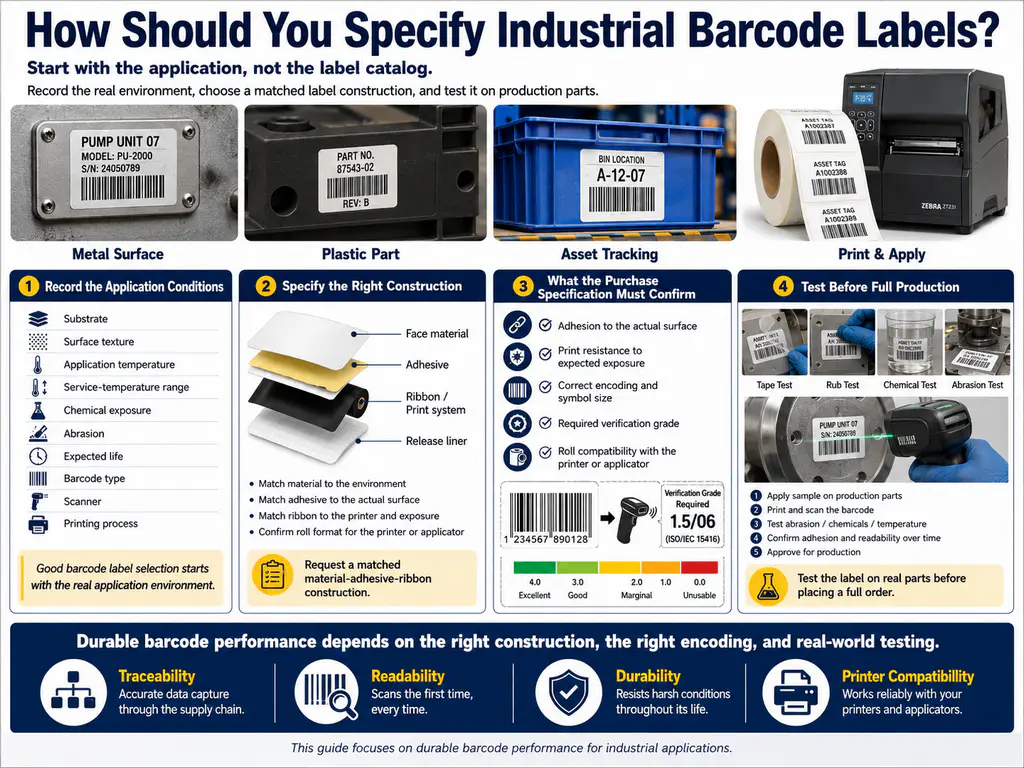
Start with the application, not the label catalog. Record the substrate, surface texture, application temperature, service-temperature range, chemical exposure, abrasion, expected life, barcode type, scanner, and printing process. Then request a matched material-adhesive-ribbon construction and test it on production parts.
A useful purchase specification must confirm adhesion to the actual surface, print resistance to the expected exposure, correct encoding and symbol size, the required verification grade, and roll compatibility with the printer or applicator.
This page concentrates on durable barcode performance. For a broader comparison of films, adhesives, and industrial environments, see Jumelage’s custom industrial labels guide.
Durable Materials and Protective Finishes
Paper is economical for clean, short-life indoor use, but films and metal constructions are better when industrial barcode labels face moisture, chemicals, abrasion, or years of service.
| Face material | Practical starting range* | Relative resistance | Typical use |
|---|---|---|---|
| Coated paper | About -20 to 80 C (-4 to 176 F) | Low to moderate moisture and abrasion resistance | Work-in-process, cartons, sheltered inventory |
| Polypropylene (PP) | About -20 to 90 C (-4 to 194 F) | Good moisture resistance; moderate heat resistance | Drums, plastic containers, indoor logistics |
| Polyester (PET) | About -40 to 150 C (-40 to 302 F) | Strong dimensional stability and good chemical resistance | Equipment, tools, electrical cabinets, long-life assets |
| Polyimide | About -40 to 260 C (-40 to 500 F), depending on construction | Excellent high-temperature stability | PCB processing, reflow, high-heat manufacturing |
| Anodized aluminum or metalized constructions | Application-specific | Excellent abrasion, weather, and long-life identification potential | Nameplates, outdoor machinery, harsh industrial assets |
*These are screening ranges, not product guarantees. Adhesive, topcoat, ink, ribbon, exposure duration, thermal cycling, and substrate all affect the final rating. Approve the complete construction against its technical data sheet (TDS) and a real-part test. For heat-intensive applications, Jumelage’s high-temperature label guide covers the qualification questions in greater depth.
Match the Finish to the Failure Mode
A clear overlaminate protects the image from rubbing, moisture, cleaners, and UV exposure. Gloss laminate may create glare under some scanner angles; matte laminate reduces reflection but still needs barcode verification. A printable topcoat is useful when variable information is added after conversion.
Compatible resin ribbon on PET may be sufficient indoors. Add an overlaminate for repeated wiping, sliding contact, outdoor exposure, or aggressive chemicals, then test barcode readability before and after conditioning.
Apply samples to production parts using the intended cleaning method and TDS bond-building period. Condition samples for the expected risks, verify the same symbols before and after exposure, and record grade, edge lift, print loss, and residue.

Adhesive Selection and Surface Preparation
Adhesive selection begins with surface energy, texture, curvature, contamination, and application temperature. Smooth stainless steel and glass are generally easier to wet out than polyethylene (PE), polypropylene (PP), rough powder coating, or oily cast metal.
| Surface condition | Useful adhesive direction | Qualification concern |
|---|---|---|
| Smooth painted or bare metal | Permanent acrylic | Cleaner compatibility, corrosion, outdoor aging |
| Rough powder-coated metal | High-coat-weight, conformable permanent adhesive | Contact only occurs at surface peaks |
| PE or PP plastic | Adhesive designed for low-surface-energy substrates | Plastic grade, mold release, surface-energy variation |
| Oily metal | Oil-tolerant industrial adhesive | Oil migration and contamination level |
| Small curved component | Flexible face material plus high-tack adhesive | Flagging caused by material stiffness |
| Cold or frozen surface | Low-temperature application adhesive | Application temperature is different from service temperature |
Peel and shear figures are useful only when test method, substrate, dwell time, and temperature are identical. Ask for results in N/25 mm or oz/in with the corresponding method. High peel does not automatically mean good shear, chemical resistance, or performance on a rough surface.
For a repeatable trial, follow the equipment owner’s cleaning procedure. Where permitted, degrease, wipe with isopropyl alcohol, let the surface dry, and apply the label above its minimum application temperature with even pressure. Obtain approval before abrading or priming a coated part.
Record the part material, coating, cleaner, application temperature, dwell time, edge lift, residue, and barcode grade. Jumelage’s pressure-sensitive adhesive guide explains tack, peel, shear, acrylic, rubber, and silicone systems.
Printing Methods, Printer Compatibility, and Ribbons
Thermal transfer is the usual choice for durable variable data because the ribbon can be matched to paper, PP, PET, or specialty films. Direct thermal needs no ribbon, but its image can darken or fade under heat, light, friction, and chemicals, so it better suits short-life logistics. Preprinted digital, flexographic, screen-printed, or laser-marked constructions may suit fixed data.
| Print system | Best fit | Main limitation |
|---|---|---|
| Direct thermal | Short-term work-in-process | Limited life under heat, UV, and chemicals |
| Wax thermal transfer | Economical coated paper | Low abrasion and solvent resistance |
| Wax-resin thermal transfer | Paper and selected films | Media matching is essential |
| Resin thermal transfer | PET and synthetic films | Higher cost and print energy |
For durable industrial barcode labels, qualify media and ribbon as a system. A resin ribbon is not automatically durable on every synthetic topcoat. Request a compatibility recommendation from both the labelstock and ribbon supplier, then test the exact printer. Jumelage’s thermal transfer labels guide provides a focused explanation of wax, wax-resin, and resin pairing.
Start trials at the media supplier’s recommended heat and speed. If bars spread, reduce energy or adjust speed. If the image is pale, check printhead cleanliness, ribbon orientation, pressure, and compatibility. Calibrate the media sensor and keep quiet zones free of text, borders, coating changes, and die-cut edges.
Before ordering, confirm printer model, resolution, roll outside diameter, core inside diameter, winding direction, gap or mark sensing, ribbon ink side, and maximum label thickness.
Barcode Symbology, Standards, and Verification
Choose the symbol from the data and trading requirement, not appearance. GS1’s barcode standards overview is the authoritative starting point when identifiers must work across supply chains.
| Symbology | Appropriate use | Procurement note |
|---|---|---|
| Code 128 | Internal serial numbers, locations, assets, mixed alphanumeric data | Compact and flexible, but not automatically a GS1 data carrier |
| GS1-128 | Logistics units and structured GS1 application identifiers | Requires correct identifiers, data fields, and human-readable information |
| UPC/EAN | Retail point-of-sale identification | Use an assigned GS1 identification number; do not invent a retail code |
| Data Matrix | Small components, direct part or compact traceability data | Requires a 2D imager and suitable module size |
| QR Code | URLs, service records, customer-facing or larger data payloads | Confirm data governance and destination longevity |
Barcode verification is different from testing whether one scanner can read a symbol. Linear symbols are commonly evaluated under ISO/IEC 15416 and 2D symbols under ISO/IEC 15415. Check the ISO standards catalogue for the current edition and follow applicable GS1 and customer requirements.
There is no universal grade for every receiving program. Put the required standard, minimum grade, verifier configuration, and measurement stage directly on the purchase order.
Incoming Verification Checklist
- Confirm encoded data, check digit, dimensions, bar height, and quiet zones.
- Verify samples from the beginning, middle, and end of a production run.
- Record the overall grade and the parameter causing any low result.
- Repeat verification after environmental conditioning and retain the report, material lot, ribbon lot, and print settings.
For labels that must also reveal removal or deter substitution, use a separate security construction. Jumelage’s security barcode labels guide covers destructible films, VOID effects, and tamper evidence; it serves a different intent from ordinary durable identification.
Sizes, Formats, Security Features, and ROI
Industrial barcode labels are available on rolls, sheets, fanfold stacks, or as individual pieces. Rolls generally suit thermal-transfer printing and automatic application. Confirm label and liner dimensions, gap, core, outside diameter, winding, perforation, and dispensing direction. Keep bleed outside the barcode clear area.
Optional features include tamper-evident films, destructible materials, sequential numbering, RFID inlays, and reinforced metal tags. RFID plus a visible barcode offers non-line-of-sight reading and a visual fallback, but adds encoding controls, read-zone testing, and metal/liquid compatibility work.
Compare total deployed cost, not label price alone:
Deployed cost per asset = label + printing/ribbon + encoding + application labor + verification + expected replacement/rework cost
MOQ and lead time vary with material, die availability, printing, serialization, security features, and documentation. Request a quotation covering prototypes, production MOQ, sample timing, tooling, tolerances, packaging, and confirmed production lead time.
Ordering Checklist for Industrial Barcode Labels
Send the following information with your RFQ:
- Use, service life, destination market, and annual quantity
- Substrate grade, coating, texture, curvature, and photographs
- Application/service temperature and environmental exposure
- Symbology, data sample, size, orientation, and target grade
- Printer, resolution, ribbon, scanner, and applicator models
- Label dimensions, roll/core format, and winding direction
- Required documentation, prototypes, validation plan, and launch date
Request blank and printed samples. A short production-equipment trial often reveals more than a long email exchange.
FAQ
What material is best for industrial barcode labels exposed to extreme temperatures?
Polyester suits many industrial assets, while polyimide is often considered for high-heat processing. Freezer or cryogenic uses require a complete low-temperature construction. Validate the label, print, adhesive, and substrate at the actual temperature and duration.
How do I choose adhesive for metal, powder coating, plastic, or oily surfaces?
Identify surface energy, roughness, contamination, curvature, and temperature, then compare data measured under the same method and run a real-part trial. Rough powder coating may need a conformable adhesive; PE and PP usually need a low-surface-energy solution.
Which barcode should I use for traceability, retail, or asset tracking?
Code 128 suits internal alphanumeric tracking, GS1-128 structured logistics data, UPC/EAN retail, and Data Matrix small spaces. QR Code suits web destinations or larger payloads. Customer standards and scanner capability take priority.
Which printer, ribbon, and media combination is most durable?
A thermal-transfer printer, resin ribbon, and compatible polyester topcoat is a strong baseline, but durability depends on the tested ribbon-media match. Tune the actual printer and verify quality before and after exposure.
What barcode grade should incoming labels achieve?
Use the minimum grade and verification method specified by the customer, industry program, or internal quality plan. State whether ISO/IEC 15416 or ISO/IEC 15415 applies and document verifier settings. A successful scan on a handheld device is not a substitute for verification.
What are typical MOQ, lead time, and sample options?
There is no dependable industry-wide figure. Stock constructions and existing dies are usually faster than custom adhesives, special films, RFID, or security features. Ask Jumelage to quote prototype quantity, production MOQ, tooling, sample timing, and confirmed production lead time for the exact specification.
Securing Your 2026 Traceability Strategy
Reliable industrial barcode labels come from treating the label, adhesive, printed image, barcode data, and scanner as one system. Jumelage helps procurement and engineering teams match durable face materials, pressure-sensitive adhesives, roll formats, and thermal-transfer compatibility to the actual asset and working environment.
Explore our Complete Catalog of Self-Adhesive Materials or contact our engineering team for an Industrial Barcode Material and Print Compatibility Review. Send a production-part sample, exposure conditions, printer model, and target barcode requirement so the proposed construction can be tested before scale-up.
