
Table of Contents
Chemical resistant labels should be specified by exposure type, not by a generic durability claim. For most harsh environments, PET film, aggressive acrylic adhesive, resin thermal transfer ribbon or durable ink, and a clear overlaminate provide stronger performance than paper or unprotected BOPP. Always test labels against the exact chemical, surface, dwell time, temperature, and cleaning method used in production.
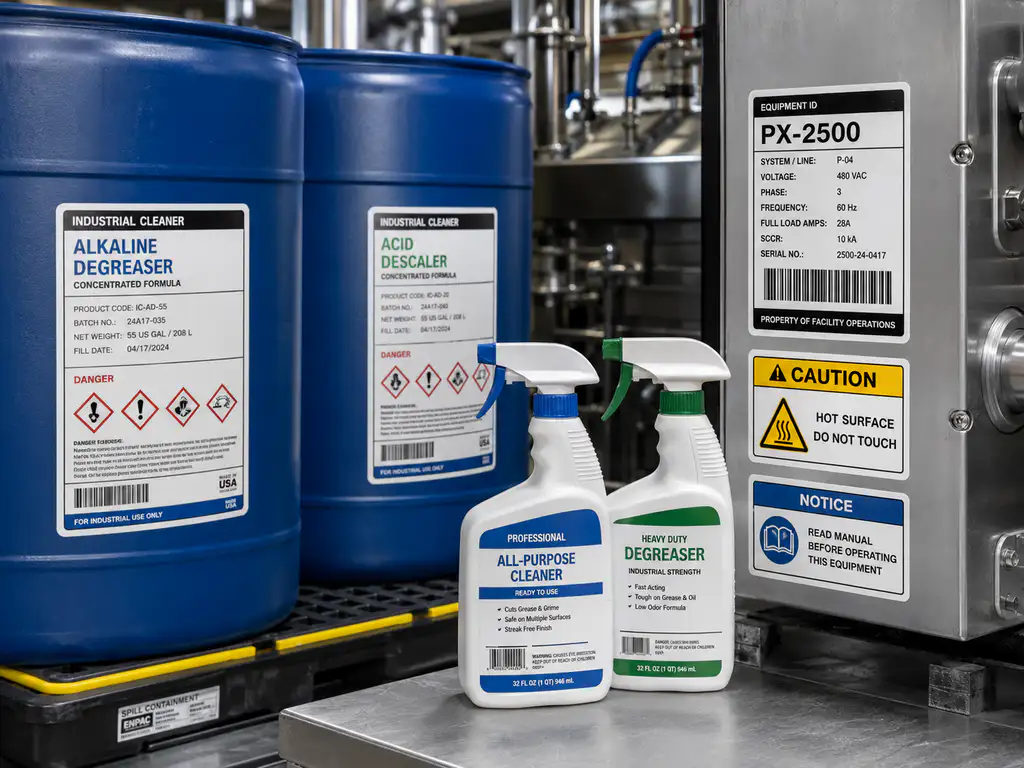
High temperature labels are essential for maintaining traceability in 2026’s extreme industrial environments. In the high-precision world of electronics…
What Are Chemical Resistant Labels?
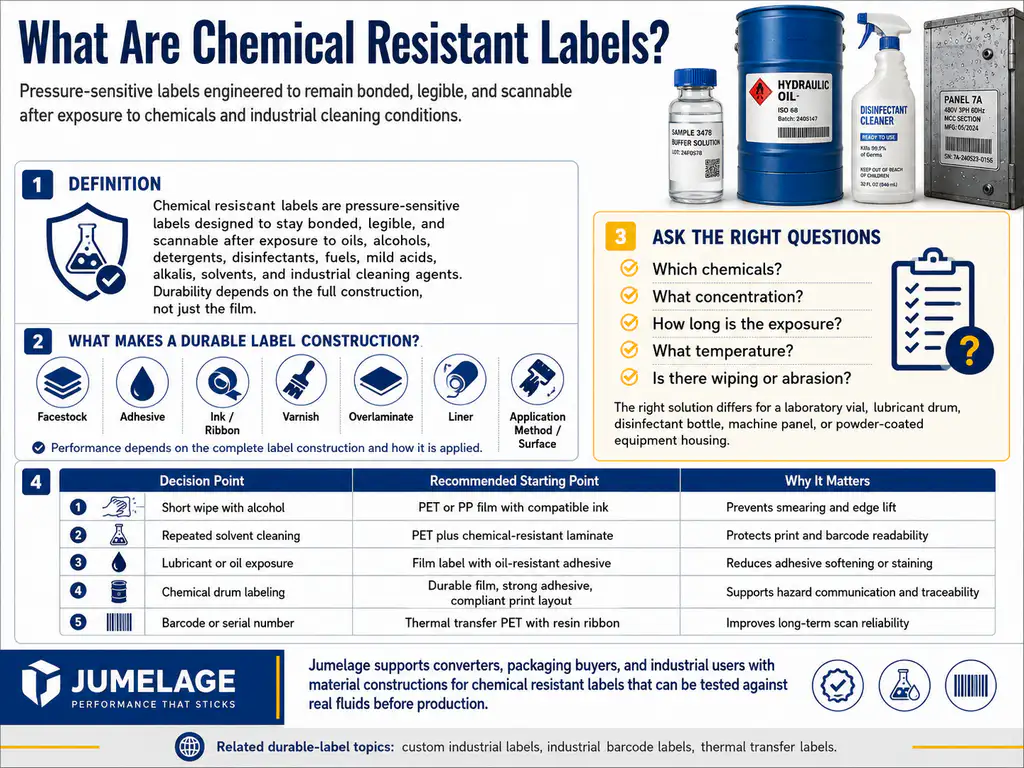
Chemical resistant labels are pressure-sensitive labels engineered to remain bonded, legible, and scannable after exposure to oils, alcohols, detergents, disinfectants, fuels, mild acids, alkalis, solvents, or industrial cleaning agents. A durable label is not defined by the film alone. It depends on the complete construction: facestock, adhesive, ink or ribbon, varnish, overlaminate, liner, and the way the label is applied to the container or equipment surface.
For buyers, the key question is not “Is this label chemical-proof?” A better question is: which chemicals, at what concentration, for how long, at what temperature, and with what wiping or abrasion? The right answer for a laboratory vial is different from the right answer for a lubricant drum, a disinfectant bottle, a machine panel, or a powder-coated equipment housing.
Jumelage supports converters, packaging buyers, and industrial users with material constructions for chemical resistant labels that can be tested against real fluids before production. If you are building a wider durable-label program, this page connects naturally with our guides to custom industrial labels, industrial barcode labels, and thermal transfer labels.
| Decision point | Recommended starting point | Why it matters |
|---|---|---|
| Short wipe with alcohol | PET or PP film with compatible ink | Prevents smearing and edge lift |
| Repeated solvent cleaning | PET plus chemical-resistant laminate | Protects print and barcode readability |
| Lubricant or oil exposure | Film label with oil-resistant adhesive | Reduces adhesive softening or staining |
| Chemical drum labeling | Durable film, strong adhesive, compliant print layout | Supports hazard communication and traceability |
| Barcode or serial number | Thermal transfer PET with resin ribbon | Improves long-term scan reliability |
Where Chemical Resistant Labels Are Used
Chemical resistant labels are common wherever ordinary labels lose readability or adhesion after contact with fluids. The most frequent applications include chemical drums, lubricant containers, industrial cleaners, disinfectant bottles, laboratory sample containers, automotive fluid packaging, machine plates, electrical cabinets, production tools, warehouse assets, and outdoor service equipment.
In these environments, failure is not only cosmetic. A blurred barcode can break inventory traceability. A lifted hazard label can create compliance risk. A stained product label can weaken brand trust. An unreadable machine ID can delay maintenance or spare-part replacement.
Common failure modes include:
- Ink dissolving or smearing after solvent wipe.
- Barcode grade dropping after abrasion.
- Label edge lifting after oil exposure.
- Film shrinking, whitening, or cracking.
- Adhesive softening under cleaner or fuel contact.
- Warning text becoming unreadable during storage.
This is why this page should be treated as a technical material selection, not as a standard sticker purchase.
Material Construction Options
The best material depends on the chemical family, surface, temperature, and required service life. For most demanding applications, polyester is the first material to evaluate because it offers dimensional stability, good abrasion resistance, and strong compatibility with resin ribbons and laminates.
| Construction | Best for | Strength | Limitation |
|---|---|---|---|
| PET film + acrylic adhesive + resin ribbon | Equipment, drums, tools, barcode labels | Strong durability and scan life | Higher cost than paper or PP |
| PP film + acrylic adhesive | Consumer chemical bottles, cleaners, short-to-mid life packaging | Good moisture resistance and flexible cost | Lower heat and solvent resistance than PET |
| BOPP film + protective varnish | Mild cleaners, cosmetic chemicals, packaging labels | Clean print surface and efficient roll production | Needs testing for aggressive solvents |
| PET film + clear laminate | Repeated wiping, disinfectants, oils, outdoor equipment | Protects print from abrasion and fluids | Adds material thickness |
| Paper + protective coating | Dry cartons or short-life chemical logistics | Economical | Not recommended for direct liquid exposure |
For heavy-duty labels, the laminate is often the quiet hero. A clear PET laminate can shield printed graphics, barcodes, GHS icons, and serial numbers from chemical splash and wiping. Without it, even a strong film may fail because the printed layer is exposed.
Adhesive selection is just as important. Smooth HDPE drums, powder-coated equipment, stainless steel, painted metal, glass, and plastic bottles all behave differently. Low-surface-energy plastics may require a more aggressive adhesive. Curved bottles may require a thinner, more conformable construction to prevent edge lift.
For applications involving heat as well as chemicals, compare this page with Jumelage’s high temperature labels guide.
Print Durability: Ink, Ribbon, and Laminate
Print durability is usually the weak point in chemical resistant labels. A film can survive chemical exposure while the printed image fails. This is especially important for barcodes, QR codes, lot numbers, serial numbers, warning text, and regulatory information.
Thermal transfer printing is a practical choice for variable data. Wax ribbons are economical but weak against chemicals. Wax-resin ribbons improve smudge resistance. Resin ribbons are the preferred starting point for PET labels that must resist abrasion, cleaners, oils, and solvents.
For preprinted labels, digital, flexographic, screen, or UV ink systems may be used depending on volume and durability needs. The print method should be matched with a varnish or laminate. If the label will be wiped repeatedly with alcohol, disinfectant, degreaser, or fuel, ask for printed samples before approving the order.
Barcode verification should be part of the test plan. A label may look readable to the eye but scan poorly after chemical exposure. For technical background on barcode systems, GS1 maintains a useful overview of barcode standards.
Chemical Resistance Testing Method
There is no single universal pass/fail rule for chemical exposure. A useful test copies the real environment as closely as possible. Laboratory standards can help structure the process, but production validation should use the actual container, adhesive surface, chemical, wipe pressure, dwell time, and temperature.
ASTM D543 covers practices for evaluating the resistance of plastic materials to chemical reagents, and ISO 175 addresses immersion testing of plastics in liquid chemicals. These standards are useful references when building a technical test plan, even though label performance also depends on adhesive and print layers.
A practical label test can follow this sequence:
- Apply labels to the actual production surface.
- Allow normal adhesive dwell time, often 24 to 72 hours.
- Expose samples to the target chemical by splash, wipe, immersion, or vapor.
- Repeat exposure at the expected service temperature.
- Check edge lift, swelling, discoloration, print smear, barcode scan, and adhesive residue.
- Record results with photos, chemical concentration, exposure time, and pass/fail criteria.
For aggressive solvents, include abrasion after exposure. In real plants, labels are rarely exposed to chemicals in a clean, untouched state. They are wiped, handled, rubbed, stacked, scraped, and scanned.
Compliance and Hazard Communication
If chemical resistant labels are used on hazardous chemical containers, durability and content both matter. In the United States, OSHA’s Hazard Communication Standard requires covered chemical labels to communicate harmonized hazard information such as signal words, pictograms, hazard statements, and precautionary statements. OSHA provides official resources on Hazard Communication and GHS pictograms.
For international programs, the United Nations’ Globally Harmonized System provides a common framework for chemical hazard communication. UNECE’s About the GHS page is a useful starting point for global context.
Jumelage does not classify your chemical hazards or replace regulatory review. The role of the label material supplier is to help ensure the chosen facestock, adhesive, and print protection can keep required information present and readable under the expected use conditions.
Specification Checklist for RFQ
Use this checklist when requesting samples or pricing:
- Chemical name, concentration, and exposure type.
- Contact method: splash, wipe, immersion, vapor, or spill.
- Exposure duration and cleaning frequency.
- Application surface: HDPE, PET, glass, steel, painted metal, powder coat, or PP.
- Application temperature and service-temperature range.
- Label size, shape, roll direction, core size, and liner requirement.
- Printing method: blank label, thermal transfer, digital, flexo, screen, or hybrid.
- Variable data requirement: barcode, QR code, serial number, batch code, or RFID.
- Required life: days, months, years, outdoor storage, or permanent equipment ID.
- Compliance documents, test reports, or customer-specific approvals.
The more specific the exposure profile, the easier it is to avoid both under-specifying and overpaying.
FAQ
What are chemical resistant labels made from?
Most durable constructions use PET or PP film, acrylic pressure-sensitive adhesive, chemical-resistant ink or resin thermal transfer ribbon, and sometimes a clear laminate. PET is usually the first choice for harsher industrial exposure.
Are chemical resistant labels solvent-proof?
No label should be called solvent-proof without testing. Some constructions resist alcohols, oils, cleaners, or mild solvents well, but aggressive solvents require sample testing against the exact chemical and exposure method.
Do chemical resistant labels need a laminate?
A laminate is strongly recommended when the printed image must survive repeated wiping, abrasion, oils, fuels, disinfectants, or solvents. It protects text, graphics, and barcodes from direct exposure.
Can chemical resistant labels be printed by thermal transfer?
Yes. PET labels printed with a compatible resin ribbon are widely used for durable barcodes, asset IDs, chemical containers, and equipment labels. Ribbon matching should be tested before volume production.
What surfaces are difficult for chemical resistant labels?
Low-surface-energy plastics such as some PP and PE surfaces, textured powder coatings, oily metals, and curved small-diameter bottles can be difficult. Surface cleaning and adhesive selection are critical.
Are chemical resistant labels required for GHS labels?
GHS or HazCom requirements define what hazard information must appear on covered chemical labels. A chemically durable label construction helps keep that required information readable during use, storage, and handling.
Securing Your 2026 Chemical Labeling Strategy
Choosing chemical resistant labels is about controlling risk: unreadable warnings, failed barcodes, edge lift, adhesive residue, and packaging that cannot survive real cleaning or chemical exposure. Jumelage helps match film, adhesive, ribbon, and laminate constructions to your container, chemical family, and service-life target.
Explore our Complete Catalog of Self-Adhesive Materials or contact our engineering team today for a custom Chemical Resistance Material Review.
