
Table of Contents
4×6 thermal labels are the standard shipping-label size used by many e-commerce sellers, warehouses, 3PLs, and parcel-shipping workflows. The 4-inch by 6-inch format gives enough space for recipient details, carrier routing codes, tracking barcodes, return information, and compliance marks while still fitting most cartons, poly mailers, padded envelopes, and shipping pouches.
For most shipping operations, 4×6 thermal labels are direct thermal labels, which means they print without ink, toner, or ribbon. The printer uses heat to darken a heat-sensitive coating on the label. That makes printing fast and convenient, but it also means buyers should check coating quality, adhesive strength, roll format, printer compatibility, barcode readability, and storage conditions before ordering in bulk.
If you are comparing label roll construction, core size, roll direction, and application details, read Jumelage’s guide to custom roll labels. This article focuses specifically on the 4×6 thermal shipping label format and how to avoid common purchasing mistakes.
High temperature labels are essential for maintaining traceability in 2026’s extreme industrial environments. In the high-precision world of electronics…
What Are 4x6 Thermal Labels?
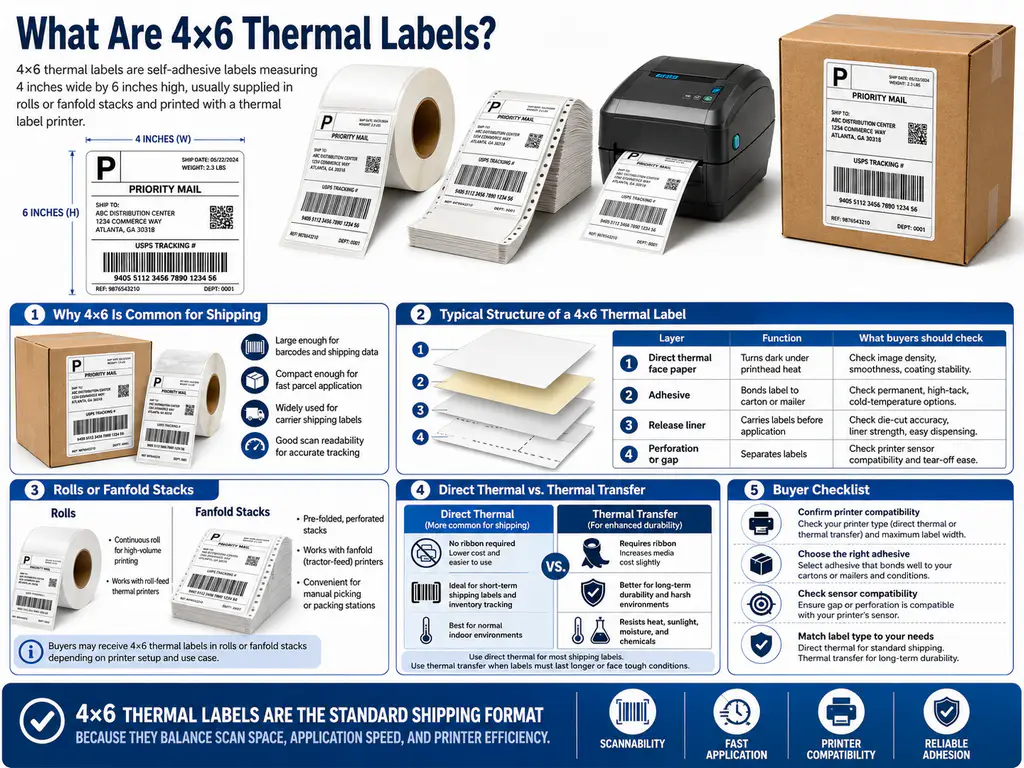
4×6 thermal labels are self-adhesive labels measuring 4 inches wide by 6 inches high. They are usually supplied in rolls or fanfold stacks and printed with a thermal label printer. The format is widely used for carrier shipping labels because it is large enough for barcodes and human-readable shipping data, but compact enough to apply quickly on parcels.
The typical structure includes:
| Layer | Function | What buyers should check |
|---|---|---|
| Direct thermal face paper | Turns dark under printhead heat | Image density, smoothness, coating stability |
| Adhesive | Bonds label to carton or mailer | Permanent, high-tack, cold-temperature options |
| Release liner | Carries labels before application | Die-cut accuracy, liner strength, easy dispensing |
| Perforation or gap | Separates labels | Printer sensor compatibility and tear-off ease |
Some buyers use the phrase “thermal labels” for both direct thermal and thermal transfer labels. For shipping, direct thermal is more common because it does not require a ribbon. For applications needing longer-term durability, heat resistance, or chemical resistance, see Jumelage’s guide to thermal transfer labels.
Why the 4x6 Format Became the Shipping Standard
The 4×6 size works because shipping labels must balance three needs: data space, scan reliability, and package fit. A label must hold the address block, tracking barcode, routing information, service level, and sometimes marketplace or return data. At the same time, it cannot be so large that it wraps around carton edges or wrinkles on small parcels.
UPS states that its online shipping tools are compatible with thermal printers that print 4″ x 6″ labels, and UPS WorldShip also supports thermal 4×6 and 4×8 label formats. That is one reason the size is familiar across logistics operations. USPS also notes that Click-N-Ship online labels should print at approximately 4″ x 6″, making thermal printing a practical choice for growing e-commerce businesses.
For warehouses, the value is simple: 4×6 thermal labels keep shipping fast. Operators can print one label at a time, apply it immediately, and avoid cutting sheets, replacing toner, or handling separate label pouches.

Roll Labels vs Fanfold Labels
4×6 thermal labels usually come in two supply formats: rolls and fanfold stacks.
| Format | Best for | Advantages | Watch-outs |
|---|---|---|---|
| Roll labels | Desktop printers, shipping stations, compact spaces | Easy to store, common printer support | Core size and outer diameter must match printer |
| Fanfold labels | High-volume shipping, shared printers, longer runs | Larger stack capacity, fewer roll changes | Needs enough rear printer space |
Rolls are a good fit for small and mid-volume e-commerce teams. Fanfold labels can be more efficient when operators print large batches and want fewer interruptions. The right choice depends on printer model, workstation layout, label volume, and how often the team changes SKUs or carriers.
Printer Compatibility: Core Size, OD, and Sensing
Before ordering 4×6 thermal labels, confirm your printer’s label specifications. A label can be the correct size and still fail if the roll does not fit the printer.
Check these details:
- Label width and height: 4″ x 6″
- Core diameter: commonly 1″, 1.5″, or 3″
- Maximum outside roll diameter
- Roll wound direction: labels out or labels in
- Gap, black mark, or continuous sensing
- Perforated or non-perforated labels
- Desktop vs industrial printer compatibility
- Print speed and darkness settings
Desktop printers often accept smaller rolls with 1-inch cores. Industrial printers may use larger rolls with 3-inch cores and bigger outside diameters. If the roll is too large, it may not fit inside the printer. If the sensor mark or label gap is wrong, the printer may skip labels, misalign barcodes, or stop during a batch.
Adhesive Selection for Shipping Surfaces
Shipping labels are applied to many surfaces: corrugated cartons, kraft mailers, poly mailers, stretch-wrapped pallets, coated boxes, and sometimes chilled packages. A standard permanent adhesive works for many clean corrugated boxes, but not every shipping surface is friendly.
Choose adhesive based on the surface and environment:
| Shipping condition | Recommended adhesive direction | Reason |
|---|---|---|
| Standard cartons | Permanent adhesive | Reliable for everyday parcels |
| Recycled or rough cardboard | High-tack adhesive | Better contact on uneven fibers |
| Poly mailers | Adhesive for low-energy plastics | Helps prevent edge lift |
| Cold warehouse or freezer | Cold-temperature adhesive | Bonds better at lower application temperatures |
| Returnable totes | Removable adhesive | Reduces residue during reuse |
For deeper adhesive behavior, Jumelage’s pressure-sensitive adhesive formulations guide explains tack, peel, shear, and aging. If shipping labels may face condensation or damp handling, compare the requirements with Jumelage’s guide to waterproof labels for bottles, especially the sections on moisture and edge lift.
Barcode Readability Matters More Than Print Darkness
A dark label is not always a scannable label. Good 4×6 thermal labels should print clean barcodes with sharp edges, stable contrast, and minimal smearing or fading during handling. Poor coating, excessive print speed, dirty printheads, or low-quality adhesive alignment can all cause barcode issues.
Before buying in bulk, print a few labels and test:
- Barcode scan from normal carrier distance.
- Scan after rubbing the printed area.
- Scan after 24 hours in storage.
- Scan after exposure to heat, sunlight, or cold if relevant.
- Scan after applying the label to the real package surface.
The global standards organization GS1 maintains barcode standards used across retail, logistics, and supply chains. For operations using GS1-128 or logistic labels, barcode size, quiet zones, and print quality should be treated as part of the label specification, not a last-minute printer setting. For tamper-sensitive or asset-tracking use, Jumelage’s security barcode labels article covers more durable identification scenarios.
Direct Thermal Limitations Buyers Should Know
Most 4×6 thermal labels are designed for short-to-medium shipping life, not permanent archival identification. Direct thermal coatings can darken or fade when exposed to heat, sunlight, friction, plasticizers, oils, or certain chemicals. That is usually acceptable for parcel shipping, where labels only need to survive fulfillment and delivery. It is less suitable for long-term asset labels, outdoor storage, or chemical drums.
For standard shipping, direct thermal is efficient because there is no ribbon. For labels that must last months or years, thermal transfer printing may be the better route. The decision should follow the required label life, not just printer availability.
How to Order 4x6 Thermal Labels
A reliable order brief should include:
- Label size: 4″ x 6″
- Supply format: roll or fanfold
- Core size and outside roll diameter
- Labels per roll or stack
- Gap or black mark sensing
- Perforated or non-perforated
- Printer model
- Surface: carton, mailer, pallet wrap, tote, or chilled package
- Application temperature and storage temperature
- Expected label life
- Barcode type and carrier platform
For e-commerce sellers, this level of detail may feel excessive at first. In practice, it prevents the most common failures: labels that do not fit the printer, labels that peel from poly mailers, barcodes that scan poorly, or rolls that stop mid-shift because the sensor cannot read the gap.
Visual Assets to Add
Use real production visuals where possible:
- Photo of 4×6 thermal labels on a desktop printer
- Roll vs fanfold comparison image
- Diagram showing core size, outside diameter, and label gap
- Barcode scan quality example
- Downloadable “4×6 Thermal Label Specification Sheet”
These visuals help buyers recognize exactly what they need before requesting a quote.
FAQ
Are 4×6 thermal labels direct thermal or thermal transfer?
Most shipping-style 4×6 thermal labels are direct thermal, meaning they print without a ribbon. Some 4×6 labels can be made for thermal transfer printing, but that is more common when the label needs longer durability.
Do 4×6 thermal labels work with any thermal printer?
No. The label size may be standard, but the roll core, outside diameter, sensing method, and wound direction must match the printer. Always check the printer specification before ordering.
Can 4×6 thermal labels be used for USPS, UPS, FedEx, and e-commerce shipping?
Yes, the 4×6 format is widely used for parcel shipping and e-commerce fulfillment. Carrier software and printer settings still need to be configured correctly for each platform.
Why are my 4×6 thermal labels fading?
Direct thermal labels can fade or darken when exposed to heat, sunlight, friction, plasticizers, oils, or chemicals. For longer-term readability, consider thermal transfer labels or a more durable construction.
What adhesive is best for 4×6 thermal labels on poly mailers?
Poly mailers often need an adhesive designed for low-surface-energy plastic. Standard carton adhesive may lift at the edges, especially during cold storage or rough handling.
Securing Your 2026 Fulfillment Strategy
Choosing 4×6 thermal labels is about protecting the shipping data your operation depends on: carrier barcodes, addresses, routing codes, return information, and warehouse traceability. By matching thermal paper quality, adhesive strength, roll format, and printer compatibility, Jumelage helps your labels move cleanly from printhead to final delivery.
Explore our Complete Catalog of Self-Adhesive Materials or contact our engineering team today for a custom Shipping Label Compatibility Audit.
