
Table of Contents
- 1. What Makes BOPP Labels Perfect for Water Bottles?
- 2. Surface Prep and Application Tips for Any Bottle Material
- 3. Designing BOPP Labels for Water Bottles
- 4. Durability, Dishwasher-Safe Performance, and Safety Standards
- 5. Cost-Effective Ordering and Sustainable Choices
- 6. Ready to Order Custom BOPP Labels for Water Bottles?
- 7. FAQ
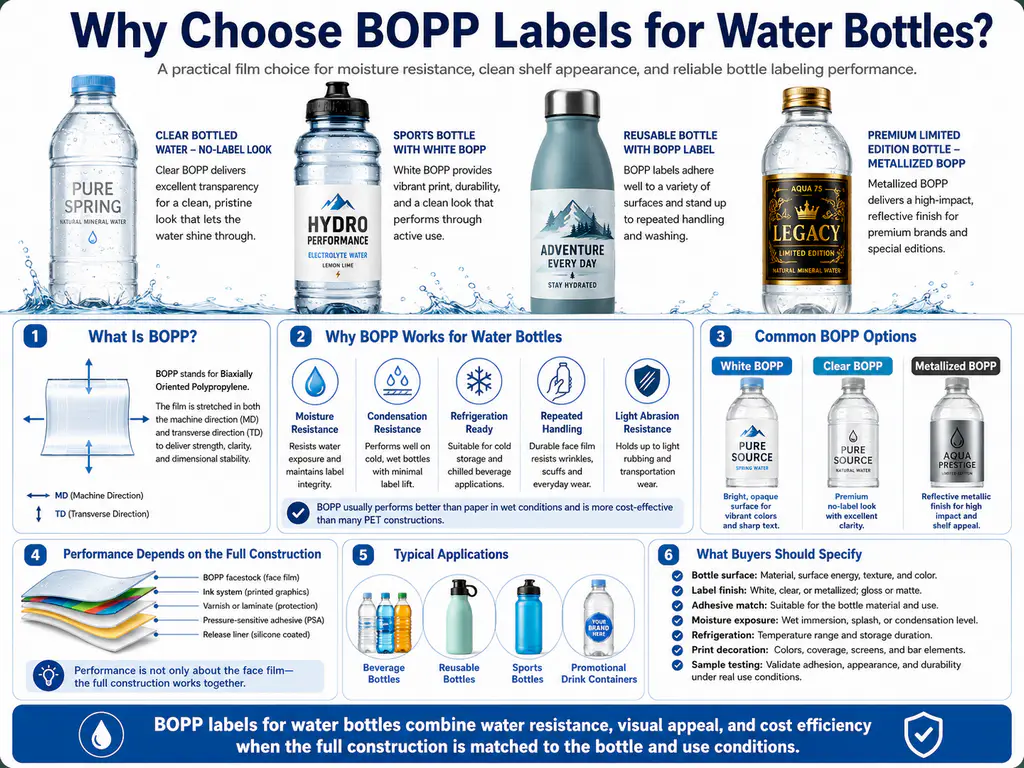
BOPP labels for water bottles are usually the best choice when a beverage, reusable bottle, sports bottle, or promotional drink container needs a clean printed look that can survive moisture, condensation, refrigeration, repeated handling, and light abrasion. BOPP stands for biaxially oriented polypropylene, a film that is stretched in two directions to improve strength, clarity, and dimensional stability.
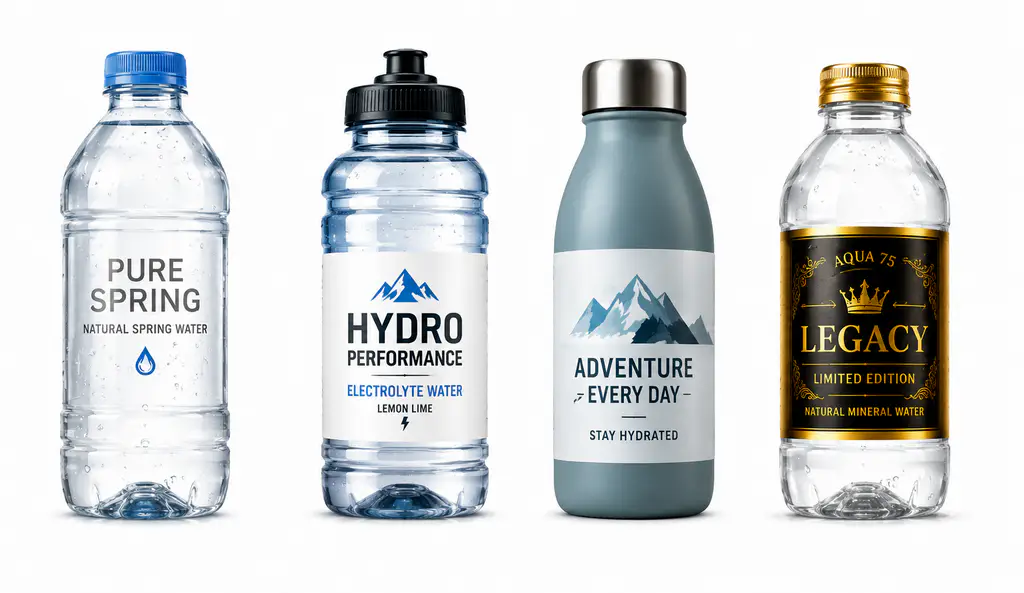
For buyers comparing bottle label materials, BOPP sits in a practical middle ground. It is more water-resistant than paper, more cost-effective than many PET constructions, and cleaner-looking than many vinyl labels for retail packaging. White BOPP gives a bright printed surface. Clear BOPP creates a premium “no-label look” on transparent bottles. Metallized BOPP can add a reflective shelf effect for limited editions or lifestyle beverage lines.
The important point is that BOPP labels for water bottles are not only about the face film. Performance comes from the full construction: BOPP facestock, ink system, varnish or laminate, pressure-sensitive adhesive, and release liner.
For a broader material comparison, read Jumelage’s guide to waterproof labels for bottles. This article goes deeper into when BOPP is the right film, how to apply it on different bottle surfaces, and what to specify before asking for samples.
High temperature labels are essential for maintaining traceability in 2026’s extreme industrial environments. In the high-precision world of electronics…
What Makes BOPP Labels Perfect for Water Bottles?
Water bottles create a difficult labeling environment. A label may be applied to PET, PP, Tritan, glass, stainless steel, or powder-coated metal. It may be handled with wet hands, moved from a refrigerator to a warm room, packed in ice, or rubbed inside a gym bag. Paper labels absorb moisture and often wrinkle or tear in these conditions. A properly specified BOPP label resists water because the film itself does not swell like paper fibers.
That is why BOPP labels for water bottles are widely used for beverage, personal care, promotional drinkware, and reusable bottle branding. The film offers good tear resistance, a smooth surface for high-quality printing, and enough flexibility for many cylindrical bottles. It is especially strong when the goal is a crisp retail appearance rather than heavy industrial durability.
Compared with vinyl, BOPP is often preferred for high-volume packaging because it gives a clean film label at an efficient cost. Compared with PET, BOPP is typically less heat-resistant under extreme stress, but it is often more economical for bottles facing moisture rather than harsh chemicals or industrial heat.
| Material | Water resistance | Visual strength | Best fit for water bottles | Watch-out |
|---|---|---|---|---|
| White BOPP | High | Bright, clean print | Retail bottled water, sports drinks, reusable bottle branding | Needs the right adhesive for low-energy plastics |
| Clear BOPP | High | Premium no-label look | Transparent PET or glass bottles | White ink may be needed behind artwork |
| PET film | Very high | Stable and durable | Heat, chemicals, or harsh handling | Higher cost than many BOPP options |
| Vinyl | High | Flexible and outdoor-ready | Curved or squeezable surfaces | Less ideal for some sustainability programs |
| Paper | Low to medium | Natural or textured | Dry-use labels, short events | Wrinkles, tears, or stains when wet |
The film is only one half of the decision. The adhesive must stay anchored when the bottle sweats. Acrylic pressure-sensitive adhesives are commonly used because they resist yellowing and moisture better than many lower-cost rubber systems. For background on adhesive behavior, see Jumelage’s pressure-sensitive adhesive guide.
Surface Prep and Application Tips for Any Bottle Material
Even excellent BOPP labels for water bottles can fail if the bottle surface is dirty, oily, too cold, or difficult for the adhesive to wet out. Glass and many PET bottles usually accept labels well. Polypropylene and polyethylene bottles can be more challenging because they are lower-energy plastics. Powder-coated metal and textured reusable bottles can also reduce initial tack.
For best application, the bottle should be clean, dry, and close to room temperature. Remove mold release agents, dust, fingerprints, and oils before labeling. On reusable bottles, avoid applying labels directly after washing unless the surface has fully dried. Trapped moisture can prevent the adhesive from forming a stable bond.
Curved bottles need extra care. A label that is too stiff, too large, or wrapped too far around a small diameter can “flag” at the edge. For narrow bottles, test a shorter panel or a more conformable construction. Apply from the center outward with firm pressure to push air away from the middle.
Condensation is the classic water bottle problem. A label that bonds well at the start may be exposed to droplets when a cold bottle enters a warm room. For large orders, request a condensation test, ice bucket test, and 24-hour dwell test before approving the full roll.
Designing BOPP Labels for Water Bottles: Shapes, Finishes, and Visual Impact
Design is where BOPP labels for water bottles can quietly win or lose. The material may be technically strong, but a poor finish choice can make the bottle look cheap or hard to read.
White BOPP is the safest option when brand colors need to stay consistent. It provides an opaque base, strong contrast for barcodes, and predictable color output. Clear BOPP is more premium but also less forgiving. If the artwork includes light colors or a logo that must remain opaque, add a white ink layer behind those elements.
Matte finishes work well for wellness brands, mineral water, cosmetics, and minimalist reusable bottle projects. Gloss finishes create stronger color saturation and a polished retail appearance. A laminate can improve scuff resistance when bottles are handled frequently, packed in cartons, or rubbed during transport.
Shape also matters. Rectangle labels are efficient and easy to apply, while rounded corners reduce edge picking. Die-cut shapes can increase shelf impact, but buyers should confirm that the shape still releases cleanly from the liner and applies smoothly at production speed.
Recommended visual assets for this blog page:
- Product photo: clear and white BOPP labels applied to glass, PET, and reusable metal bottles.
- Diagram: label construction showing BOPP film, ink, varnish or laminate, adhesive, and liner.
- Comparison chart: white BOPP vs clear BOPP vs PET vs paper.
- Short video idea: condensation test before and after refrigeration.
For artwork production, files should include bleed, safe zones, vector text, and a separate white ink indication when clear BOPP is used.
Durability, Dishwasher-Safe Performance, and Safety Standards
Many buyers ask whether BOPP labels for water bottles are dishwasher safe. The honest answer is: sometimes, but it depends on the full label construction and the number of wash cycles expected. BOPP film handles water well, but dishwashers add heat, detergent, spray pressure, and repeated expansion and contraction.
For occasional washing, a laminated BOPP label with a suitable permanent acrylic adhesive may perform well after testing. For repeated dishwasher cycles, PET may be worth evaluating if dimensional stability and heat resistance are more important than cost. For removable promotional labels, a clean-removable adhesive may be selected, but it will usually sacrifice some long-term wet strength.
Safety and compliance should also be part of the specification. Bottle labels normally contact the outside of the container, not the drink itself, but brands still need responsible material selection. In the United States, food-contact and indirect food-contact considerations are often reviewed against FDA regulations in 21 CFR. For recyclable packaging claims, marketers should also avoid vague environmental language and follow practical guidance such as the U.S. FTC Green Guides.
The most useful durability tests for BOPP labels for water bottles include:
- Condensation test after refrigeration.
- Ice bucket soak test for beverage packaging.
- Rub test with wet hands or cloth.
- Tape pull or edge-pick test after 24 hours.
- Dishwasher cycle test where reusable bottles are expected.
- Barcode scan test after moisture and abrasion exposure.
These tests are simple, but they prevent expensive packaging surprises.
Cost-Effective Ordering and Sustainable Choices
The cost of BOPP labels for water bottles depends on film type, adhesive, finish, roll size, number of colors, die-cut complexity, order quantity, liner, and inspection requirements.
Roll format is usually the best choice for commercial bottle labeling because it supports faster application and cleaner handling. Confirm unwind direction, core size, outside roll diameter, and label gap before ordering. Poor roll specification can slow the line even when the label material itself is correct.
Sustainability deserves a practical discussion. BOPP is a polypropylene film, and polypropylene is technically recyclable in many systems, but the actual recyclability of a labeled bottle depends on the total package: bottle resin, ink, adhesive, label size, and local recycling infrastructure. For basic material background, see polypropylene.
Start trials at the media supplier’s recommended heat and speed. If bars spread, reduce energy or adjust speed. If the image is pale, check printhead cleanliness, ribbon orientation, pressure, and compatibility. Calibrate the media sensor and keep quiet zones free of text, borders, coating changes, and die-cut edges.
More responsible options may include downgauged BOPP film, recyclable-compatible adhesive, reduced label coverage, liner waste reduction, or a material choice that matches the bottle resin more closely. Jumelage’s guide to sustainable self-adhesive materials gives a wider view of what is realistic at production scale.
When requesting a quote, include:
- Bottle material and surface finish.
- Bottle diameter and label size.
- Indoor, outdoor, refrigerated, or dishwasher exposure.
- White, clear, or metallized BOPP preference.
- Permanent, removable, or wash-off adhesive requirement.
- Printing method and artwork file format.
- Application method and roll direction.
- Compliance documents required by your buyer or market.
Ready to Order Custom BOPP Labels for Water Bottles?
If your label must stay clean, legible, and attractive around water, BOPP labels for water bottles are a strong starting point. The best result comes from matching the film, adhesive, finish, and roll format to the bottle surface and real use environment.
Jumelage supplies self-adhesive materials for roll label converters, packaging brands, and industrial buyers that need consistent coating quality and application performance. If your project is still in development, start with a material sample and a short application test before committing to full production.
For related packaging decisions, you may also want to review Jumelage’s guides to custom roll labels, self-adhesive packaging materials, and thermal transfer labels if your bottle labels must include variable data or barcodes.
FAQ
Are BOPP labels for water bottles truly waterproof?
Yes, the BOPP film itself is water-resistant and does not absorb moisture like paper. The final performance depends on the adhesive, ink, coating, and application conditions.
Can BOPP labels for water bottles survive in the dishwasher?
Some constructions can survive limited dishwasher exposure, especially with the right adhesive and laminate. For repeated dishwasher cycles, test samples under your actual wash conditions before production.
How do BOPP labels for water bottles handle condensation and icy conditions?
They can perform very well if the adhesive is designed for wet and cold transitions. Always test refrigerated bottles as they return to room temperature, because condensation is where weak adhesives often lift.
What is the difference between BOPP and vinyl for bottle labels?
BOPP is a clean, cost-effective polypropylene film often used for retail packaging. Vinyl is usually more flexible and outdoor-oriented, but it may not fit every brand’s sustainability or packaging requirements.
How do I design clear BOPP labels for water bottles with white ink?
Use a separate white ink layer behind logos, light text, and color blocks that need opacity. Without white ink, clear labels can look faded because the bottle or liquid shows through the artwork.
Are BOPP labels for water bottles eco-friendly and recyclable?
BOPP is polypropylene, but real recyclability depends on the bottle, adhesive, inks, label coverage, and local recycling system. Avoid broad claims unless you have supplier documentation and region-specific support.
What temperature extremes can BOPP labels for water bottles withstand?
BOPP handles normal refrigeration and wet handling well, but extreme heat can require PET or another more stable film. Use application testing for dishwashers, hot filling, sterilization, or outdoor storage.
Securing Your 2026 Water Bottle Labeling Strategy
Choosing BOPP labels for water bottles is about more than a waterproof film. It is about aligning polymer film, adhesive chemistry, print finish, and bottle surface so your brand remains clear, attractive, and reliable through refrigeration, condensation, handling, and washing.
Explore our Complete Catalog of Self-Adhesive Materials or contact our engineering team today for a custom Water Bottle Label Material Compatibility Review.
