
Table of Contents
Labels for rough surfaces need more than an adhesive that feels aggressive to the finger. A dependable construction must flow into the surface valleys, resist edge lift, and remain stable through temperature, moisture, chemicals, vibration, and handling. For most industrial applications, the starting point is a conformable film paired with a high-tack permanent adhesive and enough coat weight to make useful contact with the texture.
The best material still depends on the actual substrate. Powder-coated metal, molded plastic, recycled corrugated board, textured drums, cast housings, timber, and woven sacks all present different surface geometry and contamination risks. A sample test on the production part is therefore more valuable than selecting a label from a generic “extra strong” description.
Quick answer: what material works best on a rough surface?
For many moderately textured substrates, use a flexible PE, vinyl/PVC, BOPP, or thin PET facestock with a high-tack permanent pressure-sensitive adhesive. The adhesive should have good flow and enough coat weight to fill microscopic gaps. Rounded corners, firm pressure, and 24–72 hours of dwell help reduce edge lift. Deeply irregular, dusty, porous, oily, or moving surfaces may need a specialized construction or mechanical identification method.
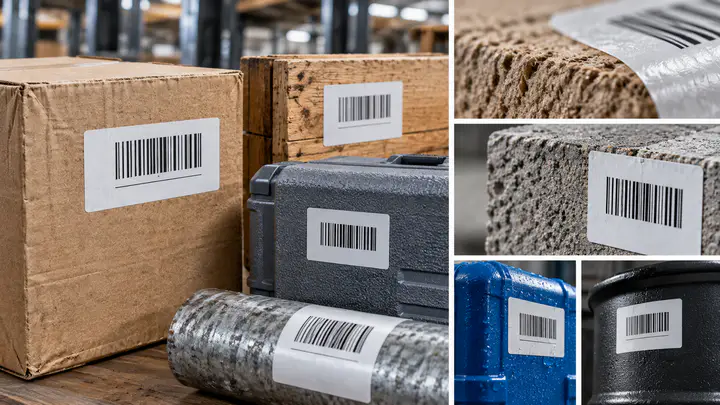
Why labels for rough surfaces fail on textured materials
A label adhesive cannot bond to air. On a rough surface, only the peaks touch at first while valleys remain uncontacted. The adhesive must deform and wet out the texture under pressure. A stiff label, hard adhesive, low coat weight, cold part, or light application pressure can prevent that contact and cause delayed corner lift.
| Observed failure | Likely cause | Better direction |
|---|---|---|
| Corners lift quickly | Low contact, stiff face, sharp corners | Conformable film, higher tack, rounded corners |
| Peels after 24 hours | Poor wet-out or contamination | Higher-flow adhesive, coat weight review, cleaning |
| Dusty or oozing edges | Adhesive too soft or too heavy | Rebalance tack, shear and coat weight |
| Flags on curved part | Facestock memory exceeds holding power | Thinner film, smaller label, larger radius |
| Varies between parts | Texture or coating changes by batch | Test several production lots |
| Coating detaches | Weak paint or surface layer | Test coating integrity first |
If the failure pattern is already visible, compare it with Jumelage’s pressure-sensitive label peel-off diagnosis guide before increasing tack.

High tack is not the same as long-term strength
“High tack” describes how quickly an adhesive forms useful contact; it does not guarantee resistance to heat, shear, chemicals, UV, or aging. A soft adhesive may wet out texture well and still creep, ooze, or weaken at elevated temperatures.
- Tack: speed and strength of the initial grab.
- Peel adhesion: force needed to remove the bonded label at a defined angle and rate.
- Shear resistance: ability to resist sliding under continuous load.
Rubber-based hot melt often provides high flow and initial adhesion on textured or low-surface-energy substrates, but selected acrylic systems can offer better heat, aging, UV, or chemical resistance. Avery Dennison’s rubber hot-melt overview describes this trade-off.
The strongest finger tack is not automatically the most reliable production specification.
How to choose a complete labels for rough surfaces construction
1. Classify the surface, not just the base material
“Metal” or “plastic” is not enough. Record whether the surface is powder-coated, cast, embossed, porous, painted, oily, curved, dusty, or weathered. Textured HDPE combines roughness with low surface energy. Use Jumelage’s metal-surface and plastic-surface guides for substrate-specific checks.
2. Choose an adhesive that can wet out the texture
Moderate roughness usually needs greater flow and initial tack than a smooth surface. A thin adhesive layer may bridge valleys; too much may ooze and disrupt die-cutting, stripping, rewinding, or storage. Select the lowest coat weight that delivers reliable contact and environmental performance.
3. Use a facestock that follows the substrate
A thick, rigid label tries to remain flat and continuously pulls against the bond. A thinner, conformable film reduces that stress.
| Facestock | Suitable use | Check |
|---|---|---|
| Flexible PE | Squeezable containers, irregular shapes | Print protection and stability |
| Vinyl/PVC | Curved equipment, panels and pipes | Plasticizers, temperature and policy |
| BOPP/PP | Mildly textured packaging | Conformability on tight curves |
| Thin PET | Equipment, barcode and asset labels | Stiffness on deep texture |
| Synthetic paper | Medium-life industrial use | Severe-environment limits |
| Paper | Rough cartons, dry short-life use | Moisture and tearing |
Compare broader facestock requirements in the custom industrial labels guide.
4. Design the shape to resist edge lift
Rounded corners distribute stress better than sharp corners. Avoid placing an edge over a ridge, seam, weld, recess, or abrupt curve. A smaller label may cross fewer variations, but it must still preserve barcode quiet zones and warning-text legibility.
5. Separate application temperature from service temperature
The adhesive must first bond at the application temperature. A freezer-rated construction may fail if applied to a cold, frosted part outside its application range. Record the part temperature, not only the surrounding air.
Material direction by rough-surface application
| Application | Starting construction | Test |
|---|---|---|
| Powder-coated machinery | Conformable PET or vinyl + high-tack acrylic | Texture, coating integrity, cleaners |
| Textured PP/PE tote | Flexible film + LSE high-tack adhesive | Release agents, flex, cold, abrasion |
| Recycled corrugated carton | Paper/synthetic paper + high-flow adhesive | Fiber tear, dust, humidity, batch variation |
| Rough chemical drum | Durable film + resistant adhesive + laminate | Chemicals, curvature, weather |
| Cast metal housing | Thin PET/vinyl + industrial high tack | Release agents, abrasion, heat cycles |
| Timber or porous board | High-coat-weight construction after review | Dust, moisture, fibers, coating |
This matrix is a sampling direction, not a universal specification. The weakest layer may be paint, dust, fiber, or contamination rather than the adhesive.
Surface preparation makes labels for rough surfaces work
Even labels for rough surfaces need a clean path to the substrate. High tack does not neutralize loose dust, oil, silicone, mold-release agents, oxidation, or weak coatings.
- Identify the substrate, coating, texture and manufacturing process.
- Remove loose dust, fibers, rust particles and debris.
- Degrease with a cleaner approved for the part and workplace.
- Dry completely to avoid trapped moisture.
- Apply within the recommended temperature range.
- Press uniformly with a rubber roller or squeegee.
- Allow dwell and inspect after 24 and 72 hours.
Do not abrade, prime, flame-treat, or solvent-clean a production part without safety and quality approval.
A sample test that gives procurement useful evidence
Laboratory values help comparison, but a smooth steel result cannot predict every textured part. ASTM’s standards list includes D3330/D3330M for peel adhesion and D6252/D6252M for 90-degree peel adhesion of label stocks. Use a consistent method, then add application-specific exposure.
- Collect representative parts from more than one production batch.
- Record texture, coating, cleaning, part temperature, and operator.
- Apply each candidate with controlled roller pressure.
- Inspect immediately, after 24 hours, and after 72 hours.
- Run heat, cold, moisture, chemical, abrasion, UV, and vibration exposures.
- Recheck edge lift, print, and barcode scanning.
- Validate printing, die-cutting, stripping, rewinding, and dispensing.
What to send when requesting a technical sample
An RFQ for labels for rough surfaces should include:
Actual substrate, coating, close-up photograph, sample part, texture and contamination state.
Label size, corner radius, curvature, flexibility and available application zone.
Application and service temperatures, water, chemicals, UV, abrasion and vibration.
Printing, laminate, barcode, roll width, core, winding, dispensing and annual volume.
These details support a complete facestock–adhesive–liner recommendation instead of a guess based on “high tack.”
FAQ
What adhesive is best for labels for rough surfaces?
A high-tack permanent adhesive with good flow is usually the starting point. Rubber hot melt can perform well on many textures, while high-tack acrylic or hybrid systems may offer better aging, heat, UV, or chemical resistance.
Does a thicker adhesive always improve adhesion?
No. More coat weight may fill surface valleys, but excess adhesive can ooze, reduce shear, contaminate dies, complicate stripping, or telescope during storage.
Can PET labels stick to powder-coated metal?
Yes, when the texture is moderate and the PET is thin enough for the geometry, paired with a suitable high-tack adhesive. Deep texture, curves, oil, weak coating, or vibration may need a more conformable film.
How long should a rough-surface label test dwell?
Inspect the initial bond, then repeat checks after 24 and 72 hours. Add longer aging and exposure for outdoor, chemical, high-temperature, safety-related or long-life use.
Build the bond around the real surface.
Choosing labels for rough surfaces is an exercise in contact, conformity, and controlled testing. Jumelage can match film flexibility, adhesive chemistry, coat weight, and liner behavior around your production and service conditions.
Explore the Complete Catalog of Self-Adhesive Materials or request a Rough-Surface Adhesion Compatibility Review.
