
Table of Contents
Quick Answer: Why pressure sensitive labels peel off
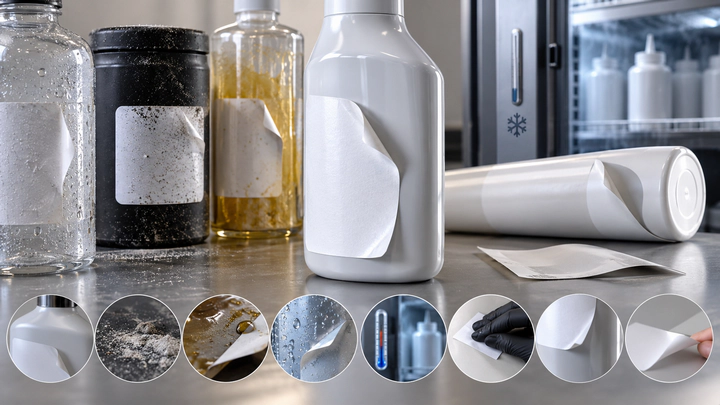
Pressure sensitive labels peel off when the adhesive cannot make enough real contact with the surface under the actual application conditions. The most common causes are low surface energy plastics, dust, oil, condensation, cold application temperature, weak wipe-down pressure, stiff facestock on a curved container, or testing the label before the adhesive has enough dwell time to build bond strength.
The first fix is not always a stronger adhesive. Surface condition, application pressure, temperature, container geometry, liner release, and storage conditions all decide whether a pressure-sensitive label forms a stable bond. Jumelage recommends diagnosing where and when the lift begins before changing materials.
For a basic definition, a pressure-sensitive adhesive bonds when pressure is applied, without water, solvent, or heat activation. That sounds simple, but the adhesive still needs clean contact, enough pressure, and suitable temperature to wet out the surface.
The first fix is not always a stronger adhesive. Diagnose where and when the lift begins before changing materials.
Do Not Start by Asking for Stronger Glue
When pressure sensitive labels peel off, many buyers immediately ask for a higher-tack adhesive. Sometimes that is right, especially on PP, PE, HDPE, rough board, or powder-coated metal. But if the surface is wet, oily, dusty, too cold, or sharply curved, a stronger adhesive may only hide the real issue for a few hours.
A better diagnostic question is: which input failed?
– Surface: material type, surface energy, coating, texture, residue, dust, or moisture.
– Pressure: applicator roller force, hand wipe-down pressure, edge contact, and label position.
– Temperature: substrate temperature at the moment of application, not just warehouse temperature.
– Dwell time: how long the adhesive has to build bond before filling, chilling, shipping, or testing.
This Jumelage guide focuses on material specification, sample testing, and RFQ details for self-adhesive material buyers.

Do not judge only by the first minute unless the final use requires immediate adhesion. Many pressure-sensitive adhesives build bond over hours or days. Check immediately, after 10 minutes, after 24 hours, and after the real exposure the package will face.
Diagnose Label Peeling by When It Happens
The timing of failure often gives the fastest clue. Use the table below before rejecting a roll lot or approving a new construction.
| When the label peels | Likely cause | What to check first | Practical correction |
|---|---|---|---|
| Immediately after application | Poor wet-out, contamination, low initial tack | Dust, oil, water film, mold-release agent, applicator pressure | Clean and dry test containers; increase wipe-down pressure; compare higher-tack adhesive |
| After a few hours | Bond did not build enough strength | Surface energy, label size, dwell time, room temperature | Allow 24 hours dwell; reduce stress at edges; test surface-specific adhesive |
| After refrigeration or freezing | Cold substrate or condensation during labeling | Bottle temperature, humidity, labeling sequence | Label before chilling when possible; test cold-apply or wet-surface adhesive |
| During shipping | Flexing, abrasion, stacking pressure, lifted corners | Pallet pattern, label placement, package deformation | Move label away from high-contact zones; round corners; use stronger film or laminate |
| Only at corners | Facestock stiffness or square-corner stress | Container diameter, label width, corner radius, film thickness | Use thinner film, smaller label, rounded corners, or more conformable facestock |
| Only on some lots | Container or process variation | Container supplier, surface treatment, label storage, humidity | Compare label lot against known-good containers and record conditions |
Surface-Specific Reasons Labels Peel
Different surfaces fail in different ways. A label that performs well on glass may lift from HDPE, and a label that bonds to smooth steel may fail on powder-coated metal. Always test the real production surface, not a substitute panel.
PET and Glass Bottles
PET and glass usually provide better bonding surfaces than untreated polyolefin plastics, but chilled beverage bottles may carry condensation, glass can hold rinse-water residue, and thin PET bottles can deform under applicator pressure. Jumelage’s guide to BOPP labels for water bottles is useful when the main problem is moisture, refrigeration, or clear film appearance.
PP, PE, and HDPE Containers
Polypropylene and polyethylene often have lower surface energy, which makes adhesive wet-out more difficult. A standard permanent adhesive may look acceptable immediately, then lift after storage. For plastic packaging, crates, caps, drums, and molded parts, review Jumelage’s article on labels for plastic surfaces.
Metal, Painted Steel, and Powder-Coated Surfaces
Bare stainless steel and smooth painted metal are often easier than textured or powder-coated surfaces. Oil film, coolant residue, cleaning chemicals, outdoor weathering, and rough coating texture can all make a label appear weak. For equipment plates, warning labels, barcode labels, and asset labels, see Jumelage’s guide to custom industrial labels.
Rough Cartons and Recycled Board
Corrugated cartons and recycled board can be dusty, porous, and uneven. If pressure sensitive labels peel off on cartons, inspect whether the adhesive reaches a stable fiber surface. High-tack adhesives, heavier coat weight, and a more conformable material can help, but board quality and application pressure still matter.
Application Temperature Is Not Service Temperature
One of the most common cold-chain mistakes is confusing application temperature with service temperature. Application temperature means the temperature of the surface when the label is applied. Service temperature means the range the finished bond can survive after it has formed.
A label may survive freezer storage after proper bonding, yet fail if applied to a cold, damp bottle. Cool temperatures can make pressure-sensitive adhesives less able to flow, reducing initial wet-out. Surface science also explains why surface energy matters when bonding to plastics and coatings.
For logistics labels, variable data, and barcode durability, Jumelage’s guide to thermal transfer labels can help match facestock, ribbon, adhesive, and application environment.
Label Construction Can Create Edge Lift
Sometimes pressure sensitive labels peel off because the construction is fighting the container shape. A thick or stiff facestock stores bending force on a curved bottle, tube, or small-diameter container. That force concentrates at the edges and corners.
- Facestock stiffness and thickness.
- Label width compared with container diameter.
- Square corners versus rounded corners.
- Heavy ink, varnish, foil, or laminate near the die-cut edge.
- Liner release that distorts the label during dispensing.
- Adhesive coat weight and adhesive chemistry.
In many curved-container projects, a more flexible facestock can outperform a stronger adhesive.
A Practical Sample Test Before Bulk Orders
Before ordering production rolls, run a small test on the actual container and in the actual environment.
- Use containers from the real production batch.
- Record surface type, cleaning method, substrate temperature, humidity, and line conditions.
- Apply each sample with consistent pressure, ideally using the same applicator or a controlled hand roller.
- Check the label immediately, after 10 minutes, after 24 hours, and after the most important exposure.
- Repeat cold storage, water exposure, squeezing, abrasion, oil wipe, chemical wipe, or outdoor exposure as needed.
- Photograph every lifted edge and record where the failure starts.
- Change one variable at a time: adhesive, facestock, label size, corner radius, or process condition.
If a formal peel test is required, ASTM D3330 is widely referenced for peel adhesion testing of pressure-sensitive tape, but production label decisions still need real-substrate confirmation.
What to Send Jumelage When Labels Peel
When pressure sensitive labels peel off, the fastest way to recommend a better material is to describe the application clearly. Send these details with your RFQ or sample request:
- Container material: PET, PP, PE, HDPE, glass, metal, coated metal, cardboard, or unknown.
- Surface condition: smooth, textured, curved, oily, wet, dusty, treated, coated, or recycled.
- Label size, shape, corner radius, and roll format.
- Printing method: flexo, UV inkjet, digital, thermal transfer, or blank stock.
- Exposure: water, condensation, freezer, heat, sunlight, oil, cleaner, solvent, abrasion, or transport.
- When peeling starts: immediately, after hours, after chilling, after shipping, or only on some lots.
- Photos of the failed label, especially whether adhesive remains on the surface.
- Required outcome: permanent, removable, repositionable, wash-off, tamper-evident, or recyclable-compatible.
This information helps Jumelage select a practical sample set and shorten the approval cycle for converters, packaging suppliers, and procurement teams.
FAQ
Why do pressure sensitive labels peel off plastic containers?
Pressure sensitive labels peel off plastic containers when the adhesive cannot wet out the surface. PP, PE, and HDPE are common trouble surfaces because they are often low surface energy materials. Mold-release residue, additives, recycled plastic variation, dust, and moisture can make the problem worse.
Will a stronger adhesive always stop label peeling?
No. A stronger adhesive helps when adhesive chemistry or coat weight is the limiting factor. It will not solve cold application, condensation, oil, dust, low wipe-down pressure, poor label geometry, or a facestock that is too stiff for the container curve.
Why do labels lift after refrigeration?
Labels often lift after refrigeration because they were applied to a cold or damp surface. The adhesive may not have formed a proper bond before the container entered cold storage. Label before chilling where possible, or test a cold-apply or wet-surface adhesive on the real container.
Why do labels peel only at the corners?
Corner lift usually points to label geometry and facestock stiffness. Square corners concentrate peel stress, especially on curved or squeezable containers. Rounded corners, a smaller label, a thinner film, or a more conformable facestock can reduce the stress.
How long should I wait before judging label adhesion?
Do not judge only by the first minute unless the final use requires immediate adhesion. Many pressure-sensitive adhesives build bond over hours or days. Check immediately, after 10 minutes, after 24 hours, and after the real exposure the package will face.
Can Jumelage provide samples if my current label is peeling?
Yes. Jumelage can review your substrate, application process, label size, roll format, and environmental exposure, then recommend sample materials for comparison. The more failure details you provide, the closer the first sample set will be.
Securing Your 2026 Labeling Strategy
Understanding why pressure sensitive labels peel off helps buyers avoid repeat failures, urgent rework, and customer complaints. By matching facestock, adhesive, liner, application process, and real-use testing, Jumelage helps converters and brand owners specify self-adhesive materials with stronger application confidence.
Explore our Complete Catalog of Self-Adhesive Materials or contact our engineering team for a custom Label Peeling Failure Review.
